Arches National Park
Park History
Sourced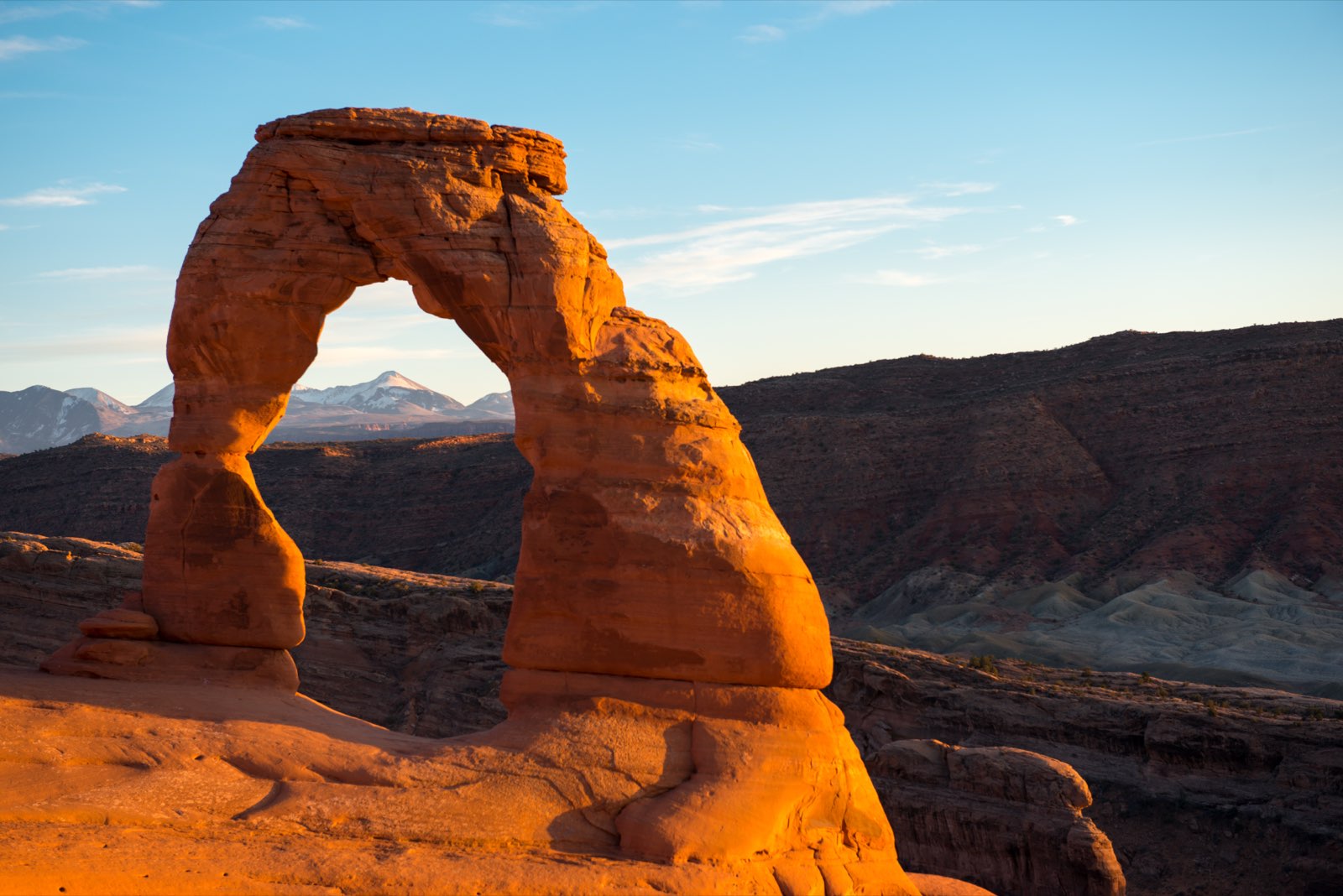
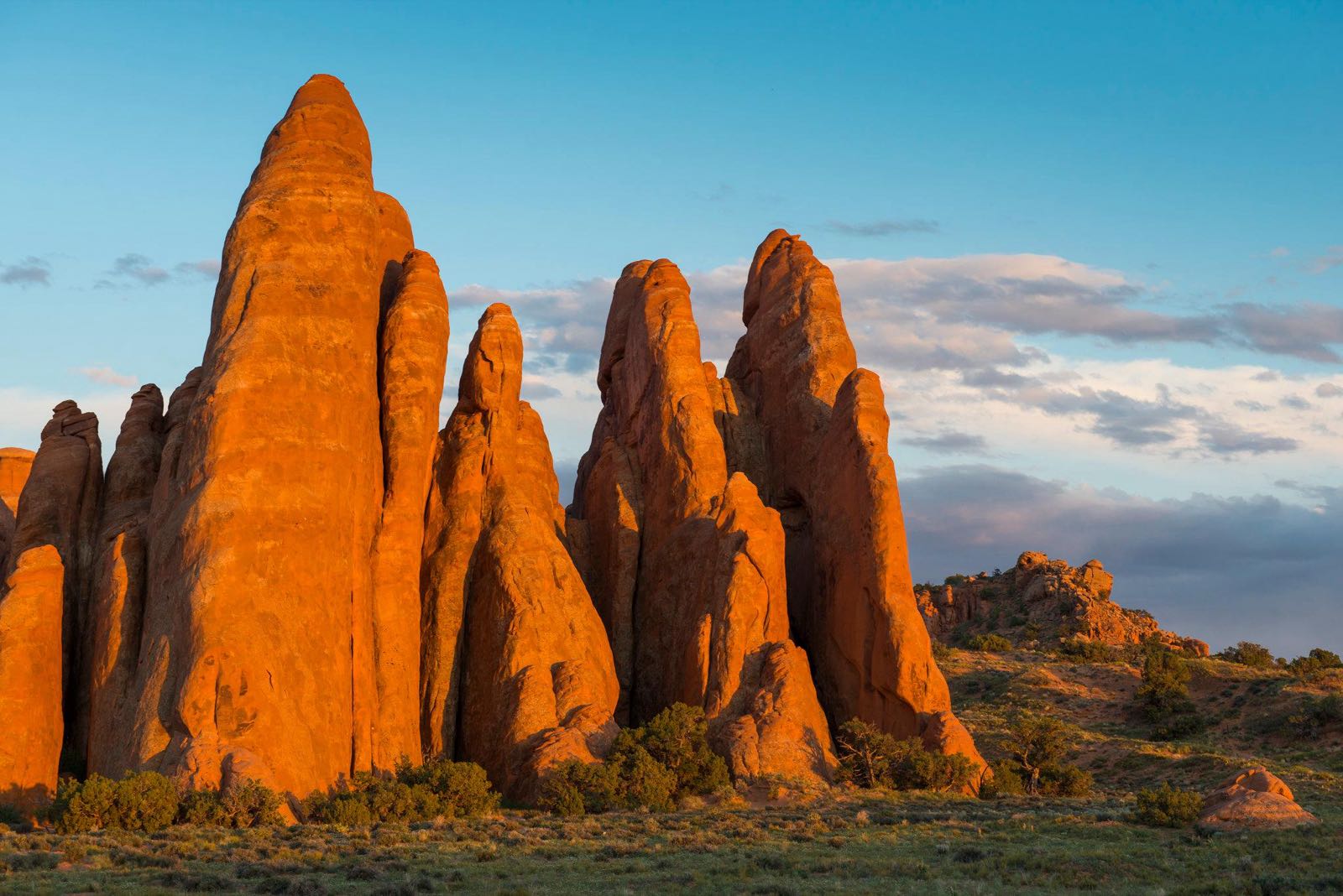
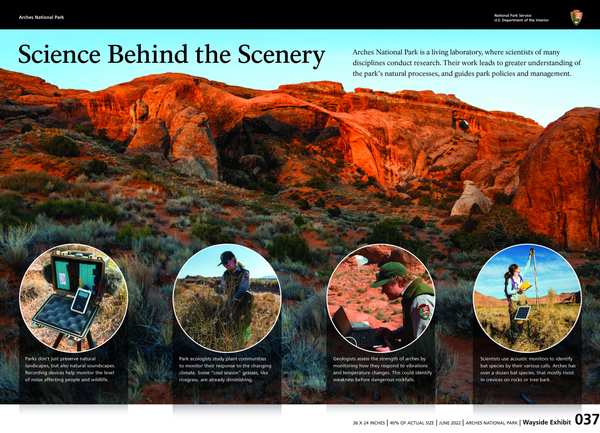
Water and ice, extreme temperatures and underground salt movement carved the red-rock country of Arches, which holds one of the world’s greatest densities of natural arches: more than 2,000 cataloged openings, from three-foot holes to Landscape Arch, 306 feet base to base. The salt bed beneath the park, thousands of feet thick in places, was laid down some 300 million years ago when a sea flooded the region and evaporated; most arches form in the salmon-colored Entrada Sandstone above it. The landscape is still changing. In 1991 a slab 60 feet long fell from the underside of Landscape Arch, and the park’s own brochure concedes that its geologic story is “probably” right, the evidence being largely circumstantial. [1]
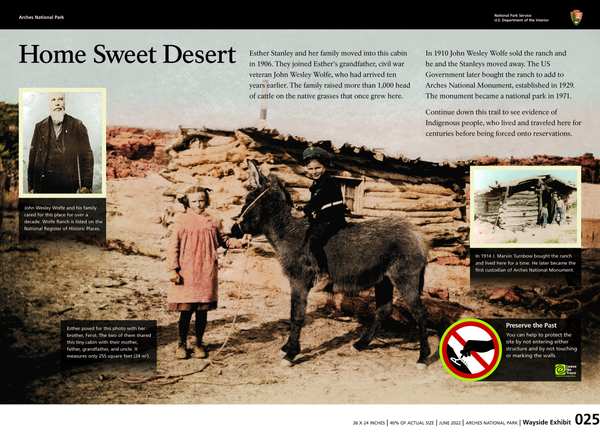
Archaic peoples, and later ancestral Puebloan, Fremont and Ute peoples, used this country for thousands of years. Disabled Civil War veteran John Wesley Wolfe and his son Fred ranched here for over 20 years from the late 1800s. [1] After prospector Alex Ringhoffer brought the formations to the attention of a railroad official in 1923, President Herbert Hoover proclaimed Arches National Monument on April 12, 1929, withdrawing 4,520 acres; an estimated 500 people visited that year. The monument grew in 1938 to take in Delicate Arch and in 1969 to 82,953 acres before Congress made it a national park of 73,379 acres on November 12, 1971. [2]
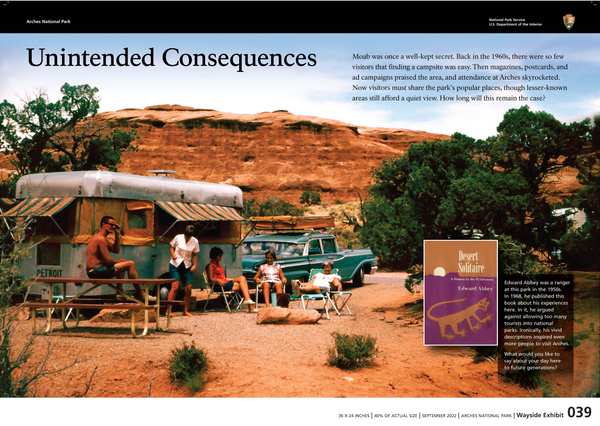
Edward Abbey, a seasonal ranger here in 1956–57, drew on those seasons for Desert Solitaire (1968). Visitation passed 1.5 million in 2016, and the park’s 2019 administrative history describes Arches as approaching the threshold of its visitor carrying capacity. [2]
Indigenous peoples
In a 2016 ethnographic study by Richard Stoffle and University of Arizona colleagues, representatives of the Pueblo of Zuni (A:shiwi), the Hopi Tribe, the Southern Ute Indian Tribe, the Ute Indian Tribe of the Uintah and Ouray Reservation, the Paiute Indian Tribe of Utah and the Kaibab Band of Paiute Indians visited five study areas in the park; each, the report says, regards Arches as a very powerful place. In their shared view the park was primarily a place of ceremony for the people who farmed Moab Valley; the arches are portals in space and time, and the hoodoos sentient beings. [3]
Hopi representatives call the region Pavayoykasi, the Place of Rainbows; Zuni representatives describe a clan migration through the park in their origin narrative; Ute representatives identified the park’s Purple Sage area as one of three known Ute gathering areas for that medicine in the Southwest. The report cautions that its summary is not an exact representation of their voices. [3]
Women
In 1982 Sherma E. Bierhaus became unit manager of Arches, a post she held until 1986. Purcell’s 2019 administrative history calls her appointment the first time a woman filled the role of superintendent at any national park, a milestone, he notes, at a time when only 22 of 333 other Park Service units were headed by women. When the state worried in 1984 that a new boundary fence would cut 100 head of cattle off from a spring-fed pond 200 feet inside the park, she replied that, given the cliffs used in the fence line, the pond would remain open to them. During her illness for much of 1983, Anna M. Fender served as acting unit manager. [2]
Climate & environment
A 2025 NPS science report used satellite images to track the park’s vegetation from 2000 to 2019, which it calls a very dry period. Dry years and multi-year dry spells caused substantial declines in plant cover that largely rebounded by the study’s end, and by then the growing season was starting on average 11.9 days earlier and ending 10.2 days later. The report offers its findings as a guide to what, where and why vegetation may change as the climate does. [4]
Labor & the New Deal
No funds were allocated for development at Arches until 1940, when a Civilian Conservation Corps camp of 200 men, NP-7-U, was built near the mouth of Moab Canyon for the monument’s exclusive use. Its crews began the entrance road up the Moab Fault, blasting the sandstone with large quantities of dynamite, and built most of the custodian’s stone residence, the Rock House (95 percent complete when the camp withdrew, by the custodian’s estimate), at a cost of 3,214 man-days and $5,830.20. [2]
The enrollees came from the Carolinas and other Deep South states and were unaccustomed to Utah’s climate. On December 18, 1940, they struck over what they felt were harsh working conditions in bad weather; the leaders were demoted, the camp telephone line was cut along some 40 poles, and the commanding officer resigned. The camp was withdrawn on May 31, 1942, with less than a mile of the scenic drive finished. [2]
Sources
- NPSHistory.com: Arches National Park archive page — overview (NPS brochure text) and establishment block
- Purcell, An Administrative History of Arches National Park (Museum of Northern Arizona for NPS, April 30, 2019) — ch. 1 timeline, ch. 7
- Stoffle, Pickering, Brooks, Sittler & Van Vlack, Ethnographic Overview and Assessment for Arches National Park (University of Arizona BARA for NPS, June 2016), ch. 1 Executive Summary
- Landscape Phenology, Vegetation Condition, and Relations with Climate at Arches National Park, 2000–2019 (NPS Science Report NPS/SR—2025/284)
FLAGGED FOR REVIEW: Interpretive materials
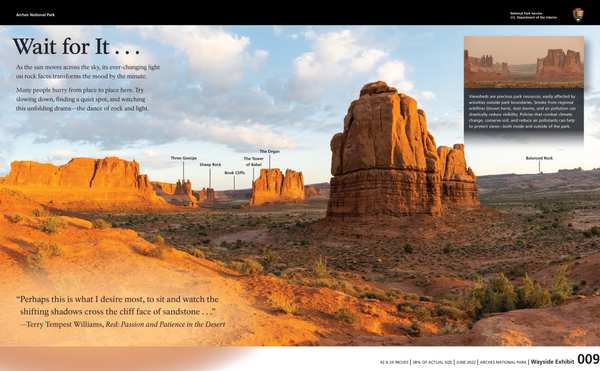
On April 12, 1929, President Herbert Hoover designated over 75,000 acres of Utah's high desert as Arches National Monument, preserving the highest concentration of sandstone arches in the world.
Contains over 2,000 natural sandstone arches, more than any other location on Earth. Delicate Arch and Balanced Rock are among the most iconic formations, carved from 150-million-year-old Entrada Sandstone. Arches formed through a complex geological process involving ancient salt deposits that bulged upward, creating fractures that water widened over millennia.
From the internal review records: “"Viewsheds are precious park resources, easily affected by activities outside park boundaries. Smoke from regional wildfires (shown here), dust storms, and air pollution can drastically reduce visibility. Policies that combat climate change, conserve soil, and reduce air pollutants can help to protect views—both inside and outside of the park."”
Why this matters: Arches reveals the dramatic sculpting power of time, water, and geology in the arid American West. Over 1.6 million people visit this site each year.
This panel's focus is on beautiful park landscapes. The park seeks guidance on whether the following inset text—which describes the impact of dust, smoke, and pollution on the viewsheds—is within scope of Secretary's Order 3431:
"Viewsheds are precious park resources, easily affected by activities outside park boundaries. Smoke from regional wildfires (shown here), dust storms, and air pollution can drastically reduce visibility. Policies that combat climate change, conserve soil, and reduce air pollutants can help to protect views—both inside and outside of the park."
Photographs attached to this park's records in the leaked NPS review database.
Explore the Full Map
See all 446 entries across every national park and wildlife refuge.
Open Interactive Map →