Glacier National Park
Park History
Sourced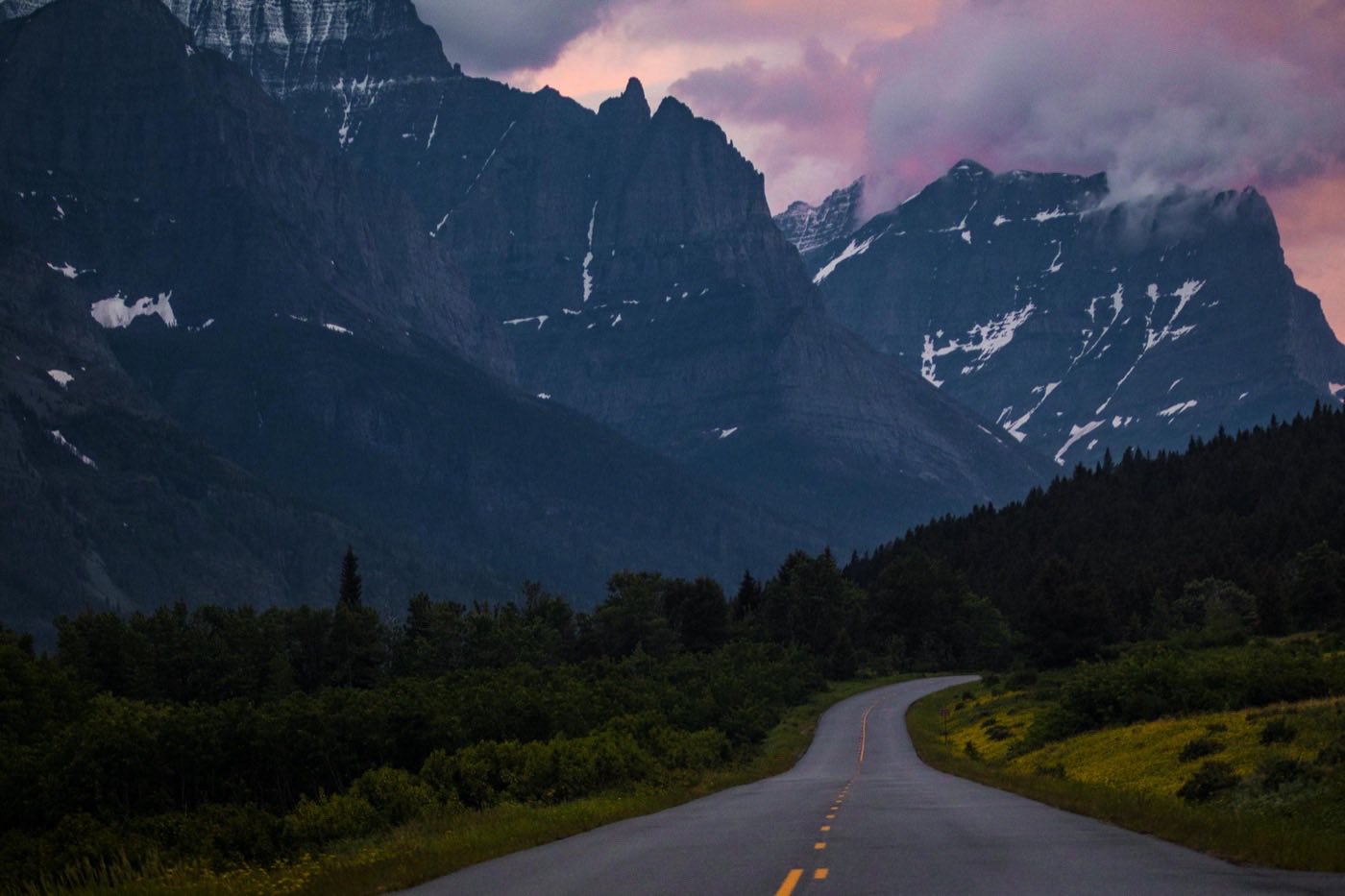
Glacier National Park protects 1,600 square miles of the northern Rocky Mountains in Montana, where the plains end abruptly against peaks built of sediments laid down 1.5 billion years ago and shoved, about 75 million years ago, over far younger rock along the Lewis Overthrust. From Triple Divide Peak, water runs to the Pacific, the Gulf of Mexico and Hudson Bay. Together with Waterton Lakes it is one of the few places in North America where all the native carnivores survive, and George Bird Grinnell named it the Crown of the Continent in 1908. [1] [2]
People have been drawn to this country for 10,000 years, and the park brochure calls it a landscape that has always been sacred to the Blackfeet, Salish and Kootenai peoples. Congress made Glacier the tenth national park on May 11, 1910; in 1932 it and Canada’s Waterton Lakes became the world’s first international peace park, later a biosphere reserve (1976) and World Heritage Site (1995). The park draws more than two million visitors a year; its Going-to-the-Sun Road, which crosses the Continental Divide at Logan Pass, was the first road designated a national historic civil engineering landmark. [2] [1]
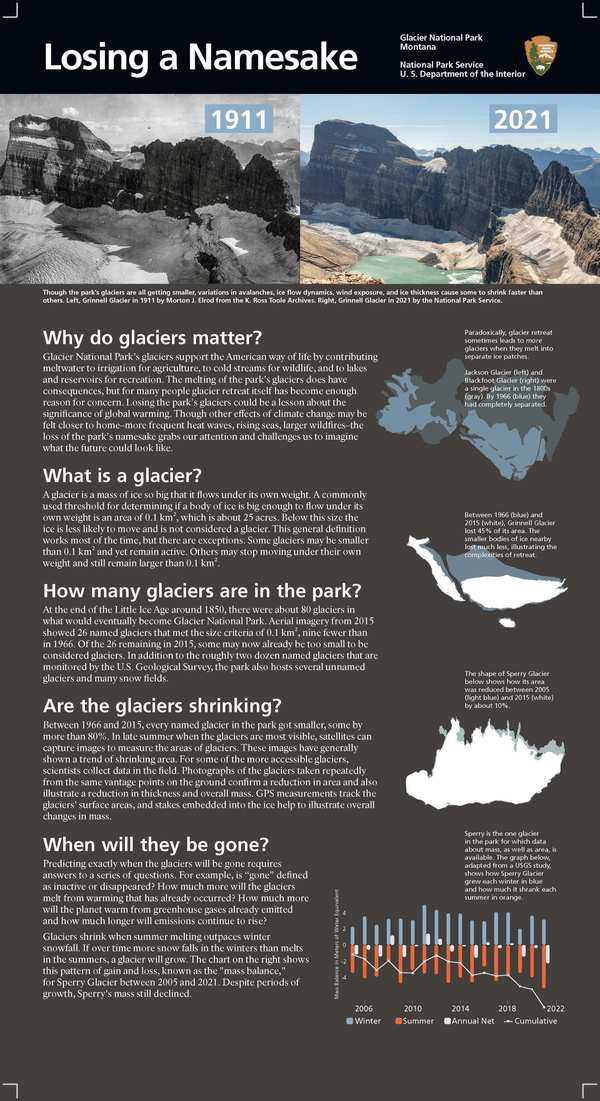
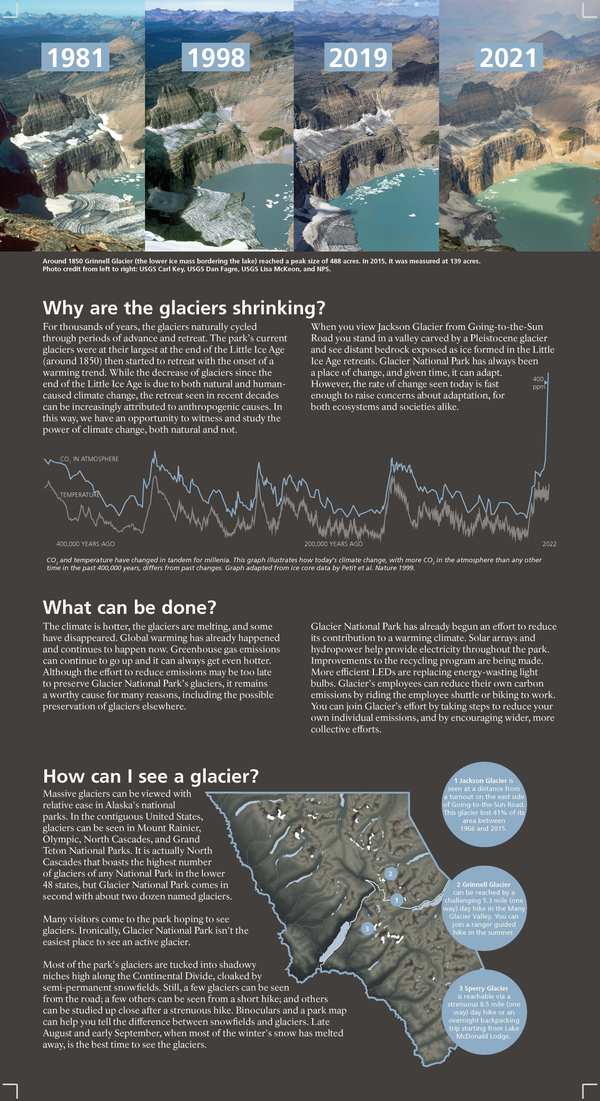
The park’s namesakes are leaving. An estimated 150 glaciers existed around 1850; by 2015 only 26 remained large enough to count as active, and the 2016 foundation document describes the last remnants of alpine glaciers as disappearing quickly due to climate change. [3] [2]
Indigenous peoples
The K’tunaxa (Kootenai) and the Piikáni, one of the three Blackfeet tribes, have ties to this country reaching back well over a thousand years; the mountains are the Piikáni’s most sacred place. On January 23, 1870, in what the 2001 ethnographic overview calls the Massacre on the Marias, Col. E. M. Baker, under orders from General Sheridan, attacked a winter camp of friendly Piikáni and killed 173 or more, mostly women, children and elders. In 1883–1885, as promised rations were delayed or never delivered, 400 to 600 Piikáni died. [4]
In September 1895 three commissioners, George Bird Grinnell among them, met Blackfeet leaders to buy the mountain lands. The Piikáni asked $3 million and received $1.5 million over ten years, plus the right to hunt, fish and cut timber while the land stayed public. The strip became part of Glacier National Park in 1910, and the government came to treat those rights as lost or severely curtailed; many Blackfeet contend they never gave them up. [4]
Climate & environment
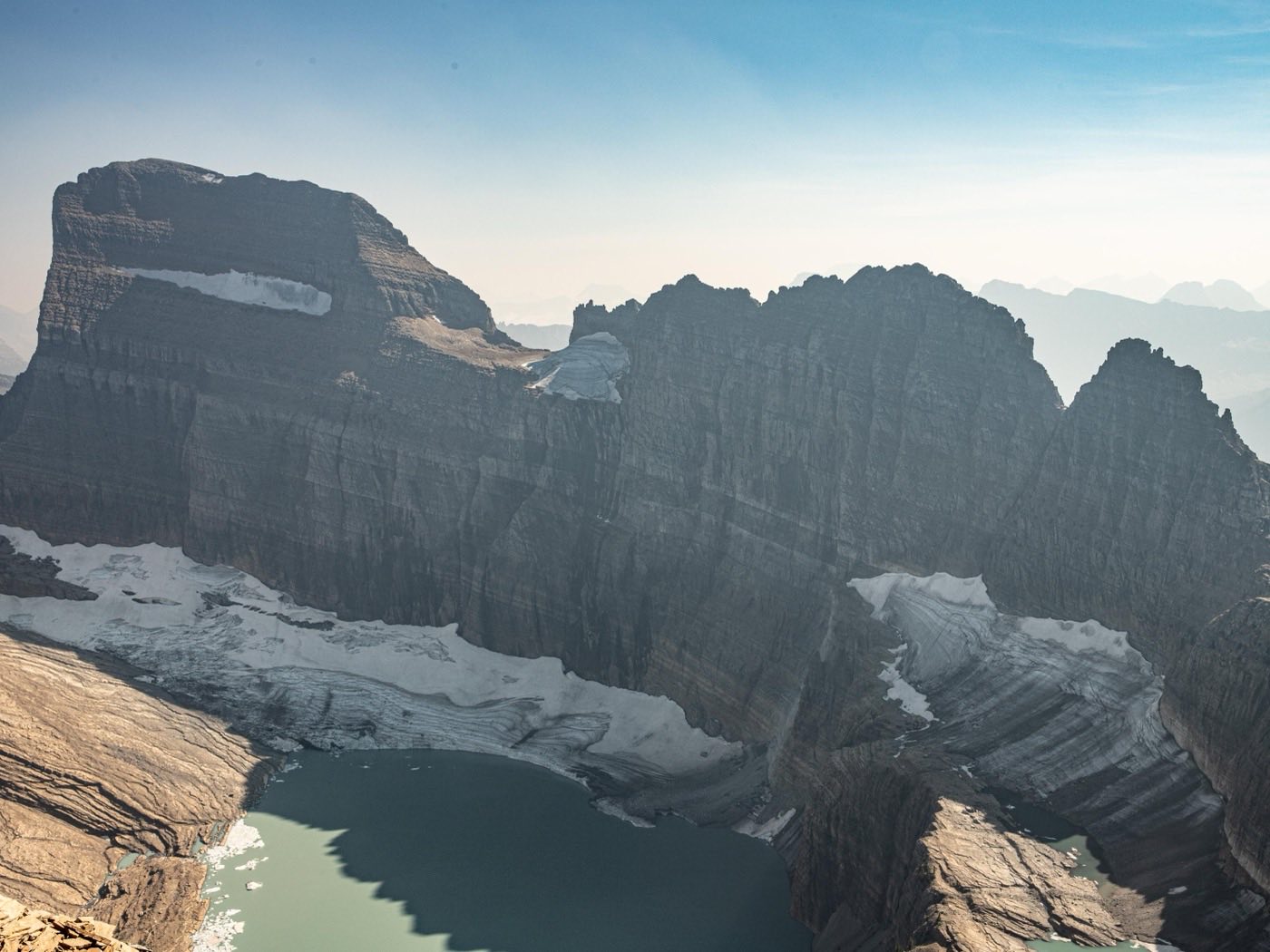
Glacier’s current ice is geologically young — formed about 7,000 years ago and at its largest around 1850, at the end of the Little Ice Age. Since 1900, the U.S. Geological Survey reports, the park region’s mean annual temperature has risen 1.33 °C, 1.8 times the global mean increase, and rain rather than snow has been the dominant form of the century’s added precipitation. Of the roughly 150 glaciers estimated in 1850, 26 were still active in 2015; Grinnell Glacier lost about 45 percent of its area between 1966 and 2015, and models project that some studied glaciers will disappear between 2030 and 2080. The loss reaches beyond scenery: glaciers act as a bank of water that keeps streams cold and flowing in late summer, and without meltwater, USGS warns, rising stream temperatures could cause local extinctions of sensitive aquatic species and harm the threatened bull trout. [3] [2]
Sources
- NPSHistory.com: Glacier archive page — overview (from the 2014 NPS brochure for Waterton-Glacier International Peace Park) and establishment block
- Foundation Document, Glacier National Park, Montana (NPS, 2016), Brief Description and Significance
- USGS, Retreat of Glaciers in Glacier National Park: 1996–2015 (2017)
- Reeves & Peacock, “Our Mountains Are Our Pillows”: An Ethnographic Overview of Glacier National Park (NPS, 2001), Executive Summary pp. vii–xiii and “The Ceded Strip — 1896,” p. 119
CONFIRMED REMOVED: Interpretive materials
On May 11, 1910, President William Howard Taft signed legislation creating Glacier National Park, the country's 10th national park, after conservationist George Bird Grinnell dubbed it the 'Crown of the Continent.'
Glacier National Park represents a unique high-elevation ecosystem with over 1,000 miles of trails crossing pristine wilderness. The park broke its 1 million visitor mark for the first time in 1969; by 2023 it exceeded 2.9 million annual visitors. Contains 25 major glaciers, though climate change has reduced their numbers from over 150 glaciers a century ago.
The administration has flagged for review content that includes the language: “emphasizing matters unrelated to the beauty, abundance, or grandeur”, and “emphasize matters unrelated to the beauty, abundance, or grandeur”. Officials deemed this language potentially “disparaging to certain visitors.”
The content at Glacier NP has been confirmed removed. Along with climate exhibits, the park took down a sign and brochures about the Marias Massacre — also called the Baker Massacre — of January 23, 1870, when U.S. Army troops attacked a winter camp of Piikáni (Piegan Blackfeet) and killed 173 or more people, mostly women, children and elders. The Blackfeet Tribal Business Council said materials documenting the massacre had been “specifically targeted for removal.” [Bozeman Daily Chronicle] [NBC Montana] [NPSHistory.com] [NPS review record]
Why this matters: Glacier’s shrinking ice is the clearest view of climate change many visitors will ever have. These mountains are also the Piikáni’s most sacred place; the government bought them from the Blackfeet in 1895, and they became part of the park in 1910. Removing both the climate exhibits and the account of the Marias Massacre leaves visitors with the scenery but not the people and forces that shaped it. [NPSHistory.com] [NPSHistory.com 2]
- “Descriptions of how climate change is contributing to glacial loss” — removed
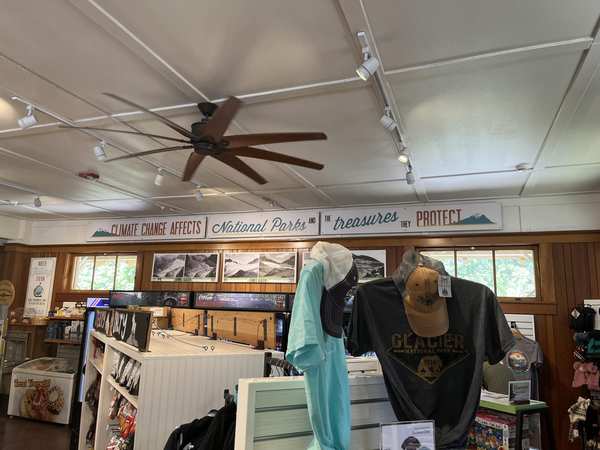
- “Climate Change Affects National Parks and the Treasures They Protect” — ordered to remove
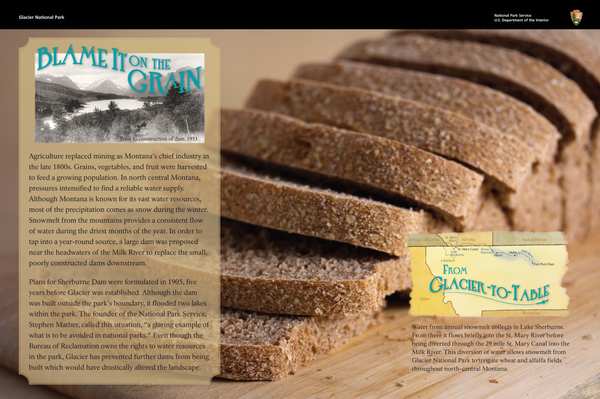
- “Blame It on the Grain” — ordered to remove
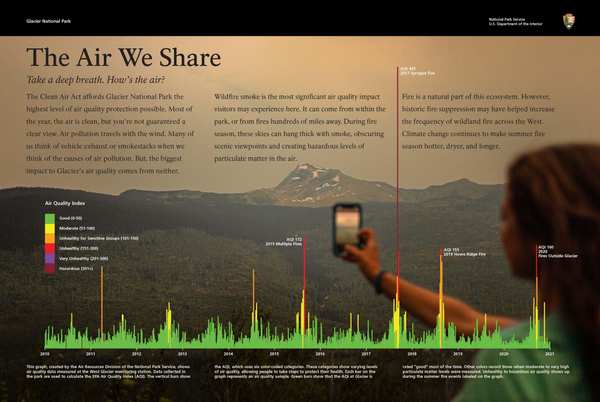
- “Fire on the Rise” — ordered to remove
- “Symbol of Controversy” — ordered to remove
- “Park Podcast” — removed
- podcast episodes removed from website
The five waysides described below were all well-researched, thoroughly reviewed by resource experts for accuracy, and are directly tied to Glacier National Park’s resources and primary interpretive themes. They are being included for higher level review to ensure they comply with SO 3431.
Photographs attached to this park's records in the leaked NPS review database.
News Sources
VerifiedExplore the Full Map
See all 446 entries across every national park and wildlife refuge.
Open Interactive Map →