Grand Canyon National Park
Park History
Sourced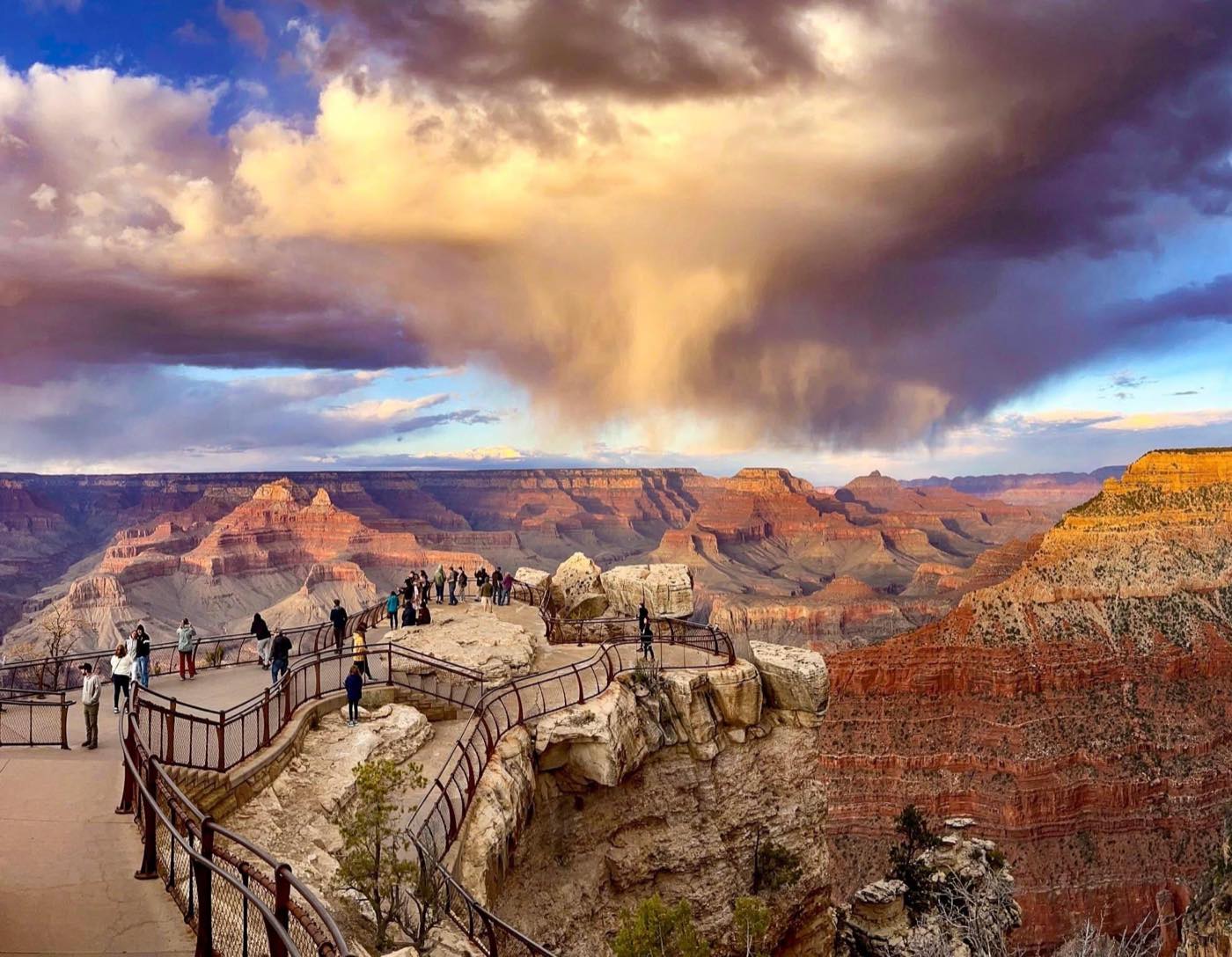
Grand Canyon is a twisting, 277-mile gorge of the Colorado River with thousands of miles of side canyons, carved over six million years. Its walls rise more than a mile above the river and expose one of the most complete geological records on Earth, from flat-lying layers that hold marine fossils down to basement rock as much as 1.84 billion years old. The park’s 1,218,375 acres run from Sonoran Desert at the bottom to conifer forest on the 8,000-foot North Rim, and 94 percent of it is managed as wilderness. [2] [1]
People have lived with the canyon for at least 12,000 years, and eleven federally recognized tribes keep strong historical, cultural and spiritual ties to it; the Navajo, Havasupai and Hualapai reservations share its boundary. President Theodore Roosevelt proclaimed 818,560 acres a national monument on January 11, 1908; Congress made it a national park in 1919, and the 1975 Grand Canyon National Park Enlargement Act nearly doubled it, to more than 1.2 million acres. It became a World Heritage Site in 1979, and visitation, averaging about 4.5 million a year, reached 6 million in 2016. [2] [3]
The park’s own brochure points to the pressure on the river: Glen Canyon Dam now releases clearer, colder water in which native fish adapted to warmer, sediment-laden water cannot thrive, and the brochure asks whether one river can meet the Southwest’s growing demand. [1]
Indigenous peoples
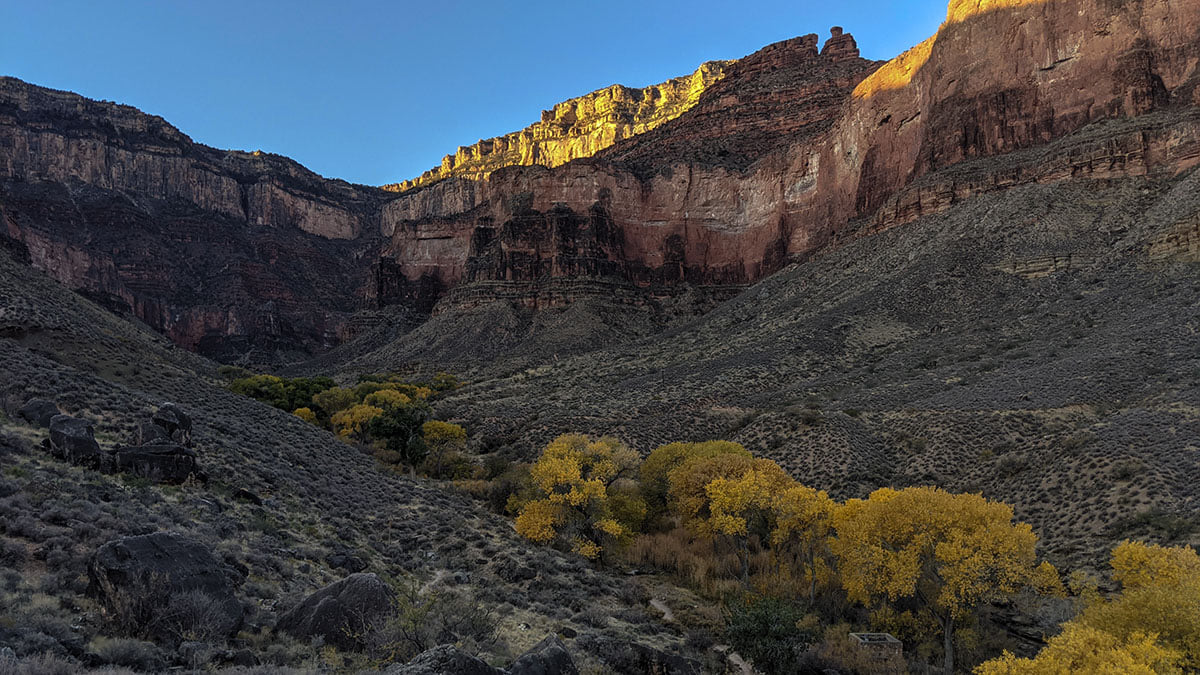
A broken spear point found in Marble Canyon shows a hunter passing through about 11,000 years ago; Puebloan people were farming the rims and river deltas by about 1,500 years ago, and split-twig figurines, masonry rooms and rock art show that the canyon sheltered people for millennia — a span the brochure puts at 600 generations. Eleven tribes — Yavapai-Apache, Havasupai, Hopi, Hualapai, Kaibab Paiute, Las Vegas Paiute, Moapa Paiute, Navajo, Paiute Indian, San Juan Southern Paiute and Zuni — still use it for trade, gathering and ceremony. [1]
The park itself displaced people. Havasupai families farmed Ha’a Gyoh, below the South Rim, until Park Service policies forced them out in the 1920s; in 2022, at the tribe’s request, the place long called Indian Garden was renamed Havasupai Gardens, and the superintendent called the renaming long overdue. The 1975 enlargement act returned 83,800 acres of park land to the Havasupai Tribe and guaranteed traditional use of another 95,300. [4] [3]
Women
Four buildings on the edge of the South Rim are the work of Mary Elizabeth Jane Colter, a Pittsburgh-born designer hired by the Fred Harvey Company and the Santa Fe Railway. Her Hopi House (1905) replicated part of the Hopi pueblo at Oraibi; Hermit’s Rest and Lookout Studio (both 1914) took their forms from the landscape, the studio rising out of the rim’s edge — “You can’t imagine what it cost to make it look this old,” she told railroad men who found Hermit’s Rest dingy. For the Desert View Watchtower, completed in 1932, she spent about six months studying ancestral Puebloan tower sites across the Southwest (Anasazi, in the form’s 1986 wording), and its Hopi Room murals are by the Hopi artist Fred Kabotie. A 1986 Park Service nomination argues that her landscape-shaped buildings helped form the architectural aesthetic for development in the national parks. [5]
Climate & environment
Grand Canyon is getting hotter. A 2024 Park Service report finds the park warmed significantly from 1895 to 2020 — 1.89 °F per century on average, and at a rate of 6.31 °F per century since 1970 — while total precipitation did not change significantly. Changes in the region already attributed at least in part to human-caused climate change include drier soils, reduced Colorado River flow and a doubling of the area burned by wildfire across the western United States; drawing on the literature, the report projects more drought, more large fires and worsening threats to archeological sites, cultural landscapes and historic structures. [6]
Mining is the other pressure. In 2012 Interior Secretary Ken Salazar closed federal lands in the Grand Canyon watershed to new mining claims until 2032, partly because, Interior found, impacts to tribal resources likely could not be mitigated. A USGS report published in 2024, co-written by Carletta Tilousi of the Havasupai Tribe, expands the risk framework for uranium mining to include the Havasupai perspective and applies it near Red Butte, a place sacred to the Havasupai, Hopi, Navajo and Zuni. [7]
Sources
- NPSHistory.com: Grand Canyon National Park archive page — overview (from the 2019 NPS brochure) and establishment block
- Foundation Document Overview, Grand Canyon National Park, Arizona (NPS, 2017)
- Anderson, Polishing the Jewel: An Administrative History of Grand Canyon National Park (2000), ch. 5, p. 67
- NPS news release, Indian Garden Now Officially Called Havasupai Gardens (November 21, 2022)
- National Register nomination, M.E.J. Colter Buildings (Hopi House, Hermit’s Rest, Lookout Studio, Desert View Watchtower), NPS Southwest Region, 1986
- Lawrence et al., Historical and Projected Climate Change for Grand Canyon National Park and Surrounding Areas (NPS NRR 2024/2615), Executive Summary
- Tilousi & Hinck, Expanded Conceptual Risk Framework for Uranium Mining in Grand Canyon Watershed — Inclusion of the Havasupai Tribe Perspective (USGS OFR 2023-1092, v1.1, 2024)
CONFIRMED REMOVED: Exhibit panels
On January 11, 1908, President Theodore Roosevelt exercised the Antiquities Act to make over 800,000 acres of the Grand Canyon a national monument, protecting what he called a landscape that 'fills me with awe.'
The Grand Canyon was under attack from developers, miners, and ranchers; Roosevelt's proclamation barred settlement and resource extraction. Despite Roosevelt's action in 1908, the Grand Canyon didn't become a national park until President Woodrow Wilson signed the bill in 1919. The Colorado River carved the 277-mile-long canyon over 6 million years, exposing nearly 2 billion years of geological history.
From the internal review records: “The majority of our waysides, interior/exterior exhibits, and and other markers have not been replaced in decade or more. We have not had a museum/exhibit space had any major change or update in over 10 years. Of our ~400 waysides, approximately 70% of them need to be replaced due to sun damage and other degredation. The park has not had a major focus in this area since 2014.”
The administration has directed that this content be replaced or removed, not merely revised but eliminated from the visitor experience at Grand Canyon NP.
Why this matters: Protecting the canyon kept out mining and development, but it also displaced people who already lived there. Havasupai families farmed Ha’a Gyoh, below the South Rim, until Park Service policies forced them out in the 1920s; the 1975 Grand Canyon National Park Enlargement Act returned land to the tribe. The removed exhibit said plainly that federal officials “pushed tribes off their land” to establish the park, and visitors deserve both halves of that story. [NPS] [NPSHistory.com] [Interior Dept.] [Spokesman-Review]
- “NA” — removed
The majority of our waysides, interior/exterior exhibits, and and other markers have not been replaced in decade or more. We have not had a museum/exhibit space had any major change or update in over 10 years. Of our ~400 waysides, approximately 70% of them need to be replaced due to sun damage and other degredation. The park has not had a major focus in this area since 2014.
News Sources
VerifiedExplore the Full Map
See all 446 entries across every national park and wildlife refuge.
Open Interactive Map →