Independence National Historical Park
NPS History
NPSHistory.comIndependence National Historical Park in Philadelphia, Pennsylvania, preserves several of the most historically significant buildings in the United States, including Independence Hall — where both the Declaration of Independence and the United States Constitution were debated and adopted — and the Liberty Bell. Independence Hall, a UNESCO World Heritage Site since 1979, hosted the Second Continental Congress (1775–1783) and the Constitutional Convention of 1787. The park also includes Congress Hall, where the U.S. Congress met from 1790 to 1800 when Philadelphia served as the nation's capital, and the President's House site, which interprets the stories of the nine enslaved Africans George Washington brought to the executive mansion during his presidency.
📚 Learn More at NPSHistory.com →30 panels documented with before, after, and restored photos
Physically removed January 2025; restored by federal court order February 2026: 15 exhibit panels documenting slavery at the President's House
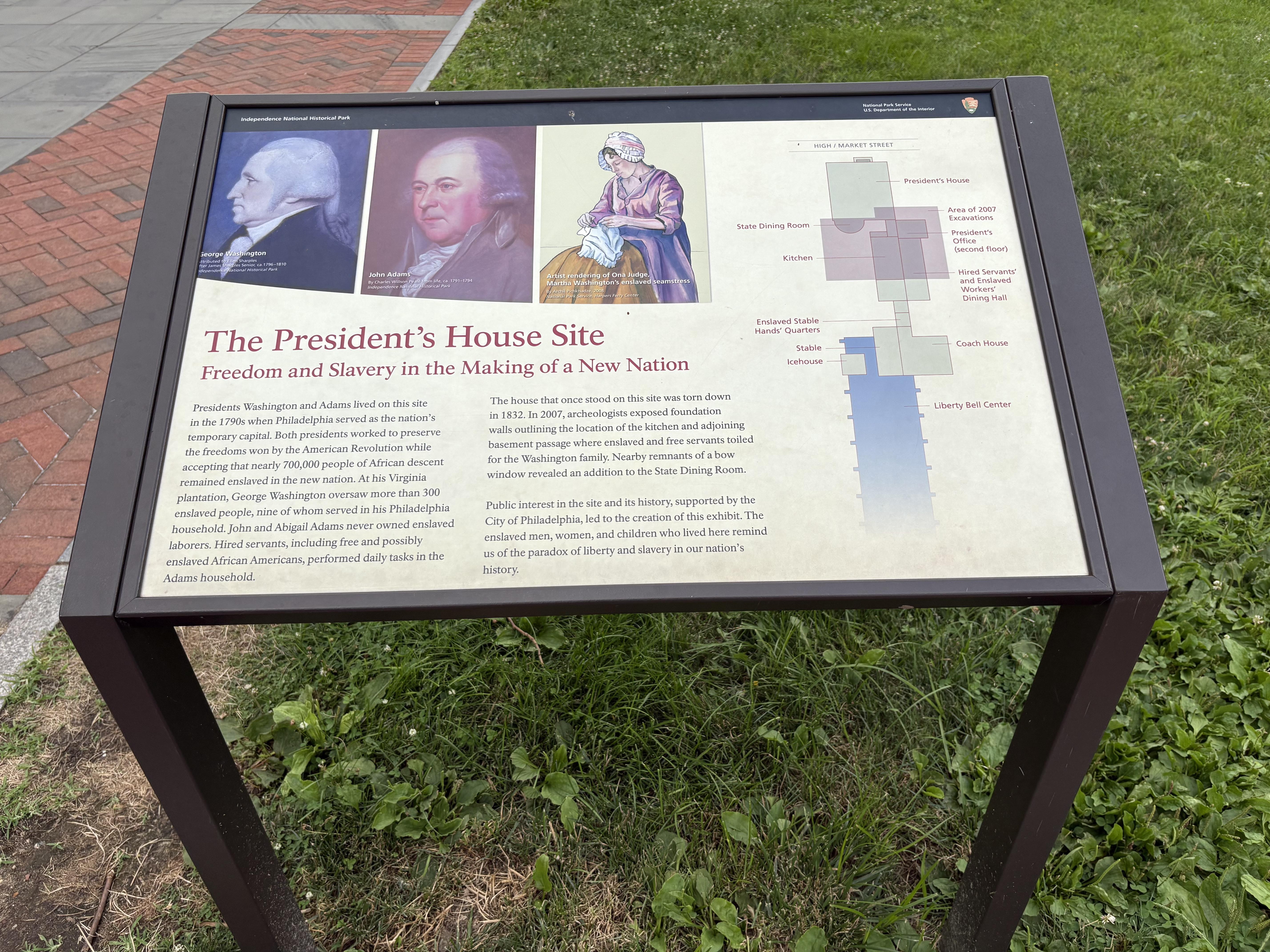
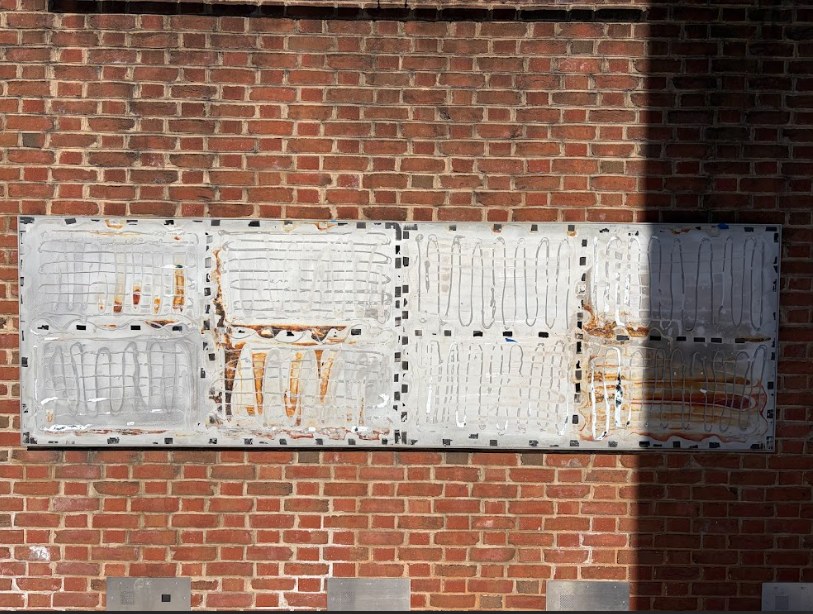
On this very ground in Philadelphia stood the President's House — the executive mansion where George Washington lived while governing a nation founded on liberty. What the exhibit revealed, and what the administration removed, is that Washington brought nine enslaved people from Mount Vernon to work in this house: Oney Judge, Austin, Christopher Sheels, Giles, Hercules Posey, Joe Richardson, Moll, Paris, and Richmond.
Washington secretly rotated these individuals between Pennsylvania and Virginia every six months to exploit a loophole in Pennsylvania's 1780 Gradual Abolition Act, which would have freed any enslaved person who resided in the state for six continuous months. In 1796, Oney Judge escaped from this house and fled to New Hampshire. Washington pursued her for years but she was never recaptured. She lived as a free woman until her death in 1848.
In January 2025, the National Park Service physically dismantled the entire exhibit. After public outcry and a lawsuit by the National Parks Conservation Association, a federal judge — citing George Orwell's 1984 — ordered the panels restored. This is the only known case where removed content has been returned.
Why this matters: The President's House exhibit was created after a 24-year campaign by Philadelphia's African American community to ensure that the story of slavery at the seat of presidential power would not be erased. Over 3 million people visit this site each year.
The administration flagged this panel because it states President George Washington was “Concerned about his public image” when he had his steward, Frederick Kitt, sign a newspaper advertisement seeking the return of an escaped enslaved woman. The government questioned: “Do we know that Washington's motivation to have Kitt sign the advertisement was to uphold his reputation?”
The administration flagged this panel because it describes methods slaveholders used to “break the spirits” of those they held in slavery, including “whipping, depriving of food, clothing, and shelter; as well as beating, torturing, and raping those they enslaved.”
The administration flagged this panel because it states that enslaved Africans were “brutally kidnapped and forcibly brought to America.”
The administration flagged this artwork because it depicts “Washington's hands in the foreground; one with the Fugitive Slave Act, the other with a quill signing the Act, in the background a posse of white men are depicted with clubs and guns shooting at four black men (one who has been shot in the head) presumably escaping from slavery.”
The administration flagged this panel because it uses words like “profoundly disturbing” to describe Washington transporting enslaved people, and calls the site's history both “admirable and deplorable.”
Revise: Exhibit panels (1 items)
On July 4, 1956, Independence National Historical Park was officially established in Philadelphia, protecting the birthplace of American democracy where the Declaration of Independence was signed in 1776.
Congress authorized the park in 1948 in response to local advocacy, and the National Park Service began administration in 1950. Independence Hall, Congress Hall, and the Liberty Bell are the centerpieces, symbolizing America's founding ideals. The park encompasses over 51 acres in downtown Philadelphia, transforming an aging commercial district into preserved historical spaces.
The administration has ordered revised content that includes the language: “Proclaim Liberty Throughout All the Land Unto All the Inhabitants Thereof,”, and “Liberty Bell.”.
In a remarkable turn, the content at Independence NHP was physically removed by the administration, only to be restored by federal court order after legal challenges. This is among the few known cases where removed NPS content has been returned to public view.
Why this matters: Independence National Historical Park preserves the physical spaces where the American republic was born and its governing documents were debated. Over 2.5 million people visit this site each year.
Please review the following panels in the Liberty Bell Center to confirm alignment with SO:
Two panels tell of how the Liberty Bell's Biblical inscription “Proclaim Liberty Throughout All the Land Unto All the Inhabitants Thereof,” a verse that in part refers to the freeing of slaves, motivated the abolitionist movement to adopt the Bell as a symbol for their cause and to give it the name “Liberty Bell.” Both panels give background to the growth and support of slavery in the US and the resistance to it, with violence on both sides. Also mentioned: George Washington holding slaves while serving as President of the US in Philadelphia and Independence Hall as a location where the Fugiti...
One section of panels cover the travels of the Bell during the Post-Reconstruction period in the United States. The section contrasts the use of the Liberty Bell as a symbol of universal freedom for the Abolitionist Movement prior to the Civil War. The introduction panel expresses how the same bell became a symbol of reunification after the Civil War as it made several trips around the nation beginning in 1885, including two trips south. It calls out the systemic and violent racism and sexism that existed in the US at that time. Another covers a visit to the Bell by the former President of th...
Revise: Exhibit panels (1 items)
On July 4, 1956, Independence National Historical Park was officially established in Philadelphia, protecting the birthplace of American democracy where the Declaration of Independence was signed in 1776.
Congress authorized the park in 1948 in response to local advocacy, and the National Park Service began administration in 1950. Independence Hall, Congress Hall, and the Liberty Bell are the centerpieces, symbolizing America's founding ideals. The park encompasses over 51 acres in downtown Philadelphia, transforming an aging commercial district into preserved historical spaces.
Among the content targeted: “Stop this Immoral War.” — language that the administration has ordered revised under its directive to review historically accurate interpretive materials.
In a remarkable turn, the content at Independence NHP was physically removed by the administration, only to be restored by federal court order after legal challenges. This is among the few known cases where removed NPS content has been returned to public view.
Why this matters: Independence National Historical Park preserves the physical spaces where the American republic was born and its governing documents were debated. Over 2.5 million people visit this site each year.
The photograph is part of a text panel that shares the different ways the American people have gathered around Independence Hall, to celebrate, commemorate, and protest. One image depicts an anti-Vietnam War protest and shows a protestor holding a poster that says, “Stop this Immoral War.” It could be construed as an opinon supported by the park.
Revise: Exhibit panels
On July 4, 1956, Independence National Historical Park was officially established in Philadelphia, protecting the birthplace of American democracy where the Declaration of Independence was signed in 1776.
Congress authorized the park in 1948 in response to local advocacy, and the National Park Service began administration in 1950. Independence Hall, Congress Hall, and the Liberty Bell are the centerpieces, symbolizing America's founding ideals. The park encompasses over 51 acres in downtown Philadelphia, transforming an aging commercial district into preserved historical spaces.
From the internal review records: “Inside Independence Hall, there is an iPad kiosk that offers a virtual tour of the second floor for visitors who are unable to access it in person. One part of the tour covers the former committee room of the Pennsylvania Assembly. The description explains that in the 1850s, when the U.S. Circuit Court used the building, this room served as the U.S. Marshal's Office. It further states that, during...”
In a remarkable turn, the content at Independence NHP was physically removed by the administration, only to be restored by federal court order after legal challenges. This is among the few known cases where removed NPS content has been returned to public view.
Why this matters: Independence National Historical Park preserves the physical spaces where the American republic was born and its governing documents were debated. Over 2.5 million people visit this site each year.
Inside Independence Hall, there is an iPad kiosk that offers a virtual tour of the second floor for visitors who are unable to access it in person. One part of the tour covers the former committee room of the Pennsylvania Assembly. The description explains that in the 1850s, when the U.S. Circuit Court used the building, this room served as the U.S. Marshal's Office. It further states that, during the enforcement of the Fugitive Slave Law of 1850, accused fugitives from slavery were held in that office—located directly above the room where the Declaration of Independence was signed.
However, the text refers to this situation as “ironic,” which may be considered inappropriate. Since the virtual tour content was developed by an outside contractor, they will need to be re-engaged to revise the language.
Flagged for Review: Film/video (1 items)
On July 4, 1956, Independence National Historical Park was officially established in Philadelphia, protecting the birthplace of American democracy where the Declaration of Independence was signed in 1776.
Congress authorized the park in 1948 in response to local advocacy, and the National Park Service began administration in 1950. Independence Hall, Congress Hall, and the Liberty Bell are the centerpieces, symbolizing America's founding ideals. The park encompasses over 51 acres in downtown Philadelphia, transforming an aging commercial district into preserved historical spaces.
From the internal review records: “When it became known that President George Washington had brought nine enslaved people from Mount Vernon to work at the residence, there was a strong call—particularly from Philadelphia’s African American community—to recognize and tell the stories of those individuals. In response, both the City of Philadelphia and the Pennsylvania General Assembly passed resolutions urging that the history of th...”
In a remarkable turn, the content at Independence NHP was physically removed by the administration, only to be restored by federal court order after legal challenges. This is among the few known cases where removed NPS content has been returned to public view.
Why this matters: Independence National Historical Park preserves the physical spaces where the American republic was born and its governing documents were debated. Over 2.5 million people visit this site each year.
Background Info: The film is part of an exhibit located on the site of the home that served as the Executive Mansion for both George Washington and John Adams. It was initially developed and largely funded by the City of Philadelphia, with additional support from the U.S. government.
When it became known that President George Washington had brought nine enslaved people from Mount Vernon to work at the residence, there was a strong call—particularly from Philadelphia’s African American community—to recognize and tell the stories of those individuals. In response, both the City of Philadelphia and the Pennsylvania General Assembly passed resolutions urging that the history of the enslaved Africans be included in the site’s interpretation.
Although the National Park Service participated in the project, oversight of the exhibit was led by an ad hoc committee formed and directed by the City of Philadelphia. The resulting exhibit focused heavily on slavery at the site and was designed as a memorial to the nine enslaved individuals who lived and worked there.
The exhibit opened in 2010. In 2015, ownership and management of the site were officially transferred to Independence National Hist...
Flagged for Review: Exhibit panels (1 items)
On July 4, 1956, Independence National Historical Park was officially established in Philadelphia, protecting the birthplace of American democracy where the Declaration of Independence was signed in 1776.
Congress authorized the park in 1948 in response to local advocacy, and the National Park Service began administration in 1950. Independence Hall, Congress Hall, and the Liberty Bell are the centerpieces, symbolizing America's founding ideals. The park encompasses over 51 acres in downtown Philadelphia, transforming an aging commercial district into preserved historical spaces.
From the internal review records: “As users progress, they learn that Franklin’s views evolved significantly. He began as a supporter of slavery—even owning enslaved people himself—but over time became a leading abolitionist. He ultimately served as President of the Pennsylvania Abolition Society and advocated for ending the slave trade during the Constitutional Convention.”
In a remarkable turn, the content at Independence NHP was physically removed by the administration, only to be restored by federal court order after legal challenges. This is among the few known cases where removed NPS content has been returned to public view.
Why this matters: Independence National Historical Park preserves the physical spaces where the American republic was born and its governing documents were debated. Over 2.5 million people visit this site each year.
This touchscreen interactive guides visitors through three key periods in Benjamin Franklin’s life, focusing on his views and actions regarding the enslavement of Africans. Using primary source documents, it invites users to evaluate whether Franklin was pro- or anti-slavery.
As users progress, they learn that Franklin’s views evolved significantly. He began as a supporter of slavery—even owning enslaved people himself—but over time became a leading abolitionist. He ultimately served as President of the Pennsylvania Abolition Society and advocated for ending the slave trade during the Constitutional Convention.
It's important to note that someone who doesn’t complete the entire interactive may walk away with the impression that Franklin was only pro-slavery, without seeing his later transformation.
I am attaching selected images from the interactive.
Please review to confirm alignment with SO 3431.
Flagged for Review: Exhibit panels
On July 4, 1956, Independence National Historical Park was officially established in Philadelphia, protecting the birthplace of American democracy where the Declaration of Independence was signed in 1776.
Congress authorized the park in 1948 in response to local advocacy, and the National Park Service began administration in 1950. Independence Hall, Congress Hall, and the Liberty Bell are the centerpieces, symbolizing America's founding ideals. The park encompasses over 51 acres in downtown Philadelphia, transforming an aging commercial district into preserved historical spaces.
From the internal review records: “Throughout the exhibits in the 2nd Bank, via the text panels, individuals portrayed in portraits are connected to people in other portraits. The text panel for the Peale portrait of Thomas Jefferson mentions Jefferson's struggles with slavery and connects him to a Philadelphia native and delegate to the Continental Congress, John Dickinson. It states that Dickinson was the 2nd largest slaveholder ...”
In a remarkable turn, the content at Independence NHP was physically removed by the administration, only to be restored by federal court order after legal challenges. This is among the few known cases where removed NPS content has been returned to public view.
Why this matters: Independence National Historical Park preserves the physical spaces where the American republic was born and its governing documents were debated. Over 2.5 million people visit this site each year.
Throughout the exhibits in the 2nd Bank, via the text panels, individuals portrayed in portraits are connected to people in other portraits. The text panel for the Peale portrait of Thomas Jefferson mentions Jefferson's struggles with slavery and connects him to a Philadelphia native and delegate to the Continental Congress, John Dickinson. It states that Dickinson was the 2nd largest slaveholder in Philadelphia at that time. It does not state that Dickinson also struggled with being a slaveholder. As a sidenote, Dickinson freed the people he enslaved in 1777.
Please review to confirm alignment with SO 3431.
Flagged for Review: Interpretive materials
On July 4, 1956, Independence National Historical Park was officially established in Philadelphia, protecting the birthplace of American democracy where the Declaration of Independence was signed in 1776.
Congress authorized the park in 1948 in response to local advocacy, and the National Park Service began administration in 1950. Independence Hall, Congress Hall, and the Liberty Bell are the centerpieces, symbolizing America's founding ideals. The park encompasses over 51 acres in downtown Philadelphia, transforming an aging commercial district into preserved historical spaces.
In a remarkable turn, the content at Independence NHP was physically removed by the administration, only to be restored by federal court order after legal challenges. This is among the few known cases where removed NPS content has been returned to public view.
Why this matters: Independence National Historical Park preserves the physical spaces where the American republic was born and its governing documents were debated. Over 2.5 million people visit this site each year.
Please review language concerning the Adams household “possibly” hiring enslaved African Americans to work in the President's house to confirm alignment with SO 3431.
Flagged for Review: Interior / Exterior Exhibits
On July 4, 1956, Independence National Historical Park was officially established in Philadelphia, protecting the birthplace of American democracy where the Declaration of Independence was signed in 1776.
Congress authorized the park in 1948 in response to local advocacy, and the National Park Service began administration in 1950. Independence Hall, Congress Hall, and the Liberty Bell are the centerpieces, symbolizing America's founding ideals. The park encompasses over 51 acres in downtown Philadelphia, transforming an aging commercial district into preserved historical spaces.
From the internal review records: “The attached is the design intent for a new exhibit for the West Wing of Independence Hall. This is to be fabricated, installed, and set to open in spring of 2026.”
In a remarkable turn, the content at Independence NHP was physically removed by the administration, only to be restored by federal court order after legal challenges. This is among the few known cases where removed NPS content has been returned to public view.
Why this matters: Independence National Historical Park preserves the physical spaces where the American republic was born and its governing documents were debated. Over 2.5 million people visit this site each year.
The attached is the design intent for a new exhibit for the West Wing of Independence Hall. This is to be fabricated, installed, and set to open in spring of 2026.
Please review to confirm alignment with SO 3134.
News Sources
VerifiedExplore the Full Map
See all 874+ entries across every national park and wildlife refuge.
Open Interactive Map →