Rock Creek Park
Park History
Sourced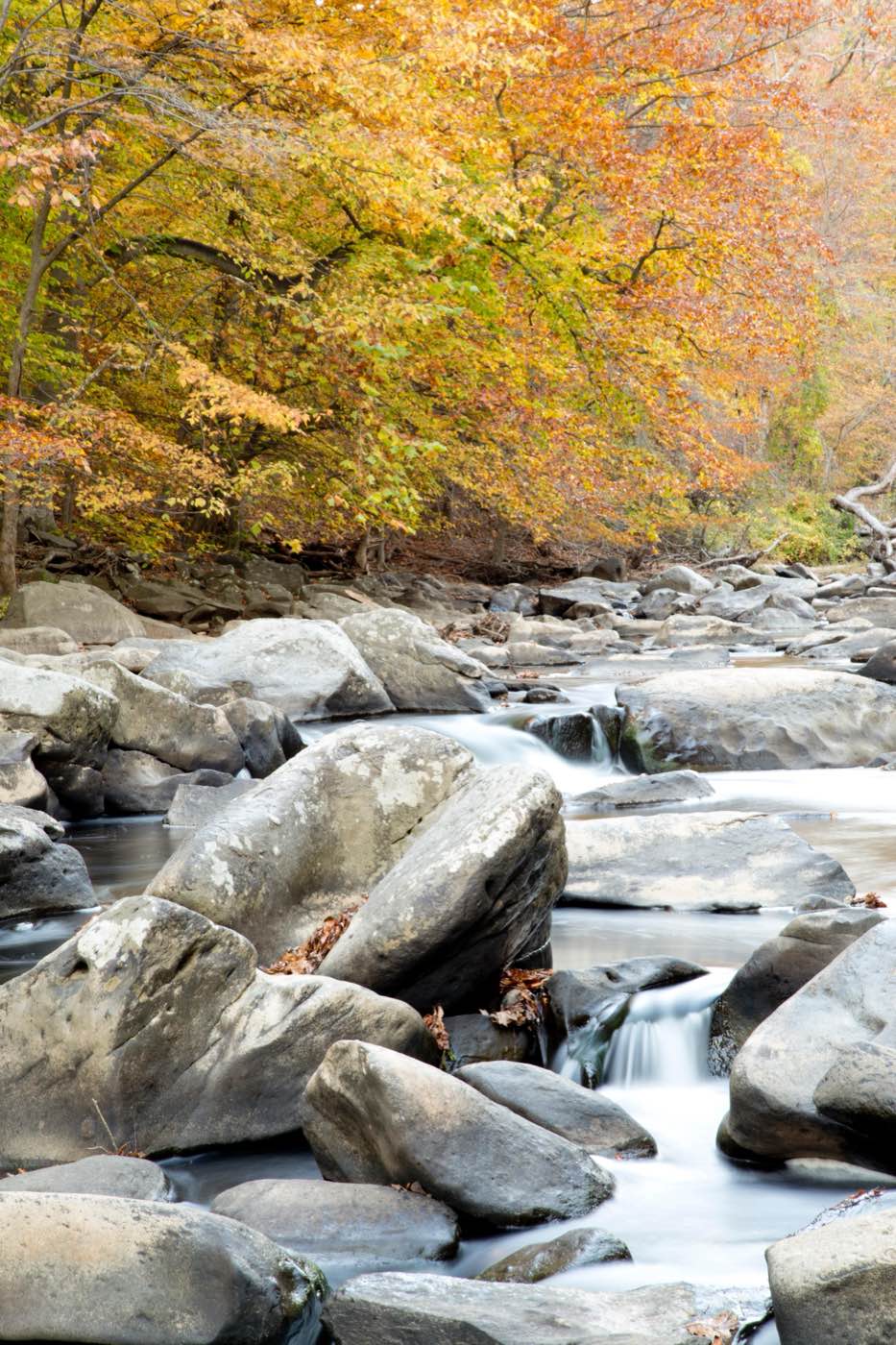
Rock Creek Park follows a 9.6-mile stretch of Rock Creek from the Maryland line to the National Zoo, a forested valley of deciduous woods, meadows, wetlands and floodplains inside the capital where 180 species of birds have been recorded. Congress established it on September 27, 1890, as a public park or “pleasure ground” whose timber, animals and curiosities were to be kept as nearly as possible in their natural condition; the 2015 foundation document calls it one of the first federal park units and, among them, unique for lying beside a city. Today the park administers 2,749 acres in 99 areas, among them the Rock Creek and Potomac Parkway, the Old Stone House, Meridian Hill Park and nine of the Civil War Defenses of Washington, including Fort Stevens. [1] [2]
Peirce Mill, rebuilt in 1820 by Isaac Peirce and his stonemason son Abner with granite quarried nearby, was the last of eight mills in the valley; its main shaft broke in 1897, ending the milling there. Two years after the park was created the government condemned the mill property, and in 1934 Interior Secretary Harold Ickes proposed restoring it as part of the Depression-era improvements to the park. [2]
Indigenous peoples
William Bushong’s 1990 historic resource study says human occupation of what is now the District probably dates back 10,000 to 20,000 years; fluted spear points found in Anacostia and northwest Washington have been dated to between 9,000 and 9,500 B.C. Inside the park, the Piney Branch quartzite quarry was, archeologists interpret, a work site for extracting stone for tools and weapons between about 3,000 and 1,100 B.C.; the foundation document notes that it supplied important evidence in the debate over the history of human presence in the Americas. Park Service archeologists found two more sites along Rock Creek in 1985, hunting base camps where people processed meat and nuts, worked hides and made stone tools. Nearby, on the Anacostia’s east bank, lived the Nacostins (anglicized as Anacostians); when the English trader Henry Fleet sought a Potomac fur monopoly in the early 1630s, Bushong writes, they were already the middlemen in the beaver trade with interior tribes. [3] [1]
Black history
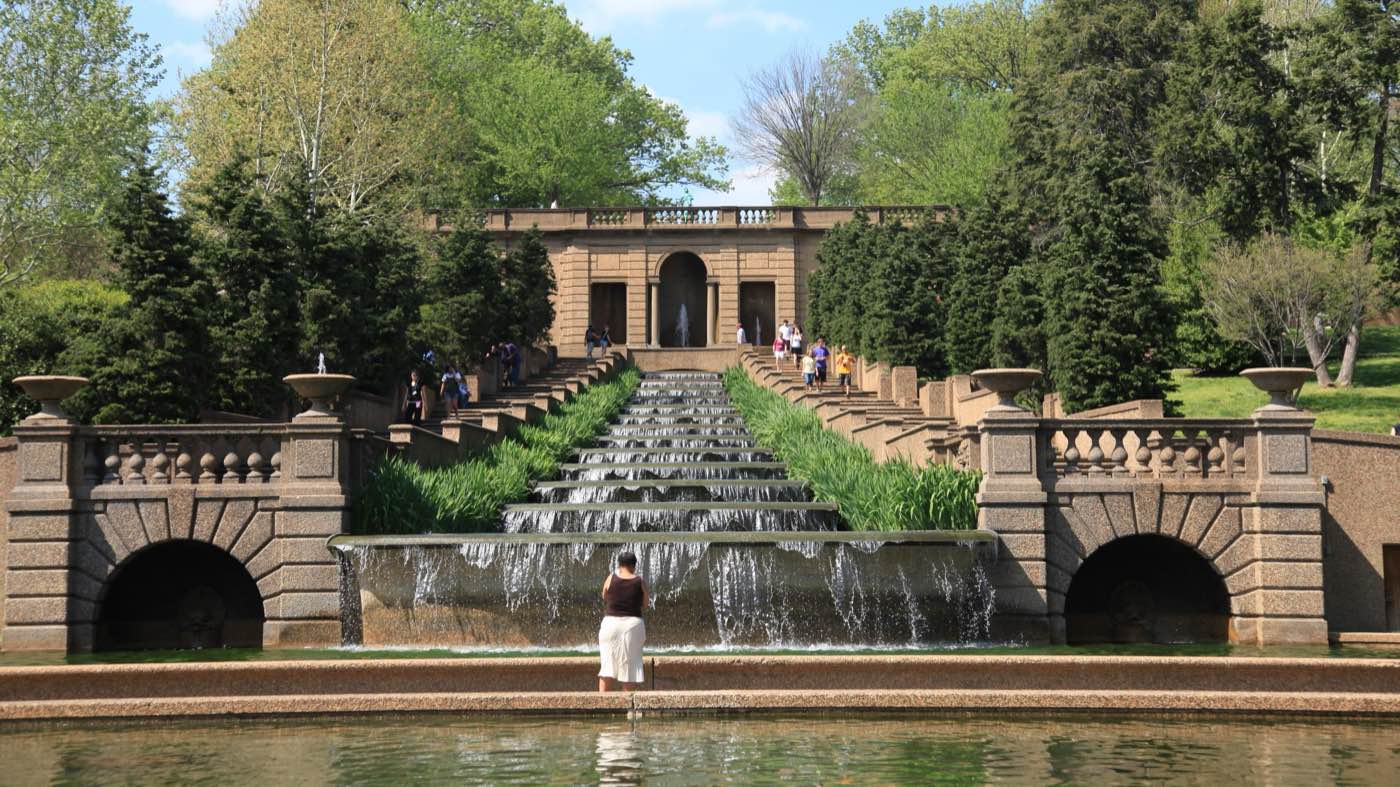
Meridian Hill Park, an 11.88-acre park managed by Rock Creek Park and colloquially called Malcolm X Park, sits on land with a long Black history. Elise Elder’s 2019 Park Service study reports that during the Civil War the Union Army’s Camp Cameron there offered food, shelter and work to freedmen and people escaping slavery, and that a Black community grew up afterward along today’s 15th Street. When the government acquired the land for the park, most of those homes were condemned, and by 1912 all of the residents had been forced to move; Black laborers were then hired to build the park. In the 1960s Black activist groups held rallies there, and after Malcolm X was assassinated in 1965 Black Washingtonians began a drum circle in his memory that the study, in 2019, called a weekend fixture ever since. [4]
Slavery
The Peirce family, who built Peirce Mill, held people in slavery. Bushong’s historic resource study, which spells the name Pierce, reads Isaac Pierce’s wealth in the census: the 1820 count, Bushong suggests, shows two enslaved families who worked as house servants, mill workers and field hands, and by 1840, a year before his death, he enslaved fourteen people, many of them children. His son Abner, who inherited the farm in 1842, also held enslaved people; the 1850 census Bushong cites lists nine children among them. Abner’s nephew Pierce Shoemaker, the next owner, held twenty people in slavery before Congress abolished slavery in the District of Columbia on April 16, 1862. [3]
Labor & the New Deal
Bushong calls the 1930s an important transitional decade for the park. Between 1934 and 1938, Public Works Administration grants paid for new bridges and buildings, the restoration of Peirce Mill, the completion of Piney Branch Parkway and the paving of park roads; in May 1934 an average of 136 laborers and 3 stonemasons a day were building the parkway and its retaining walls. Civilian Conservation Corps crews riprapped the creek, planted trees, built two miles of bridle trails and demolished the old Brightwood Reservoir. In September 1938 a CCC camp, NP-14, opened just north of Fort DeRussy with 154 enrollees; it closed when the program ended in 1942. [3]
Sources
- Foundation Document, Rock Creek Park, District of Columbia (NPS, 2015)
- NPSHistory.com: Rock Creek Park archive page — NPS brochure texts (park brochure, undated; Peirce Mill brochure) and establishment block
- William Bushong, Historic Resource Study: Rock Creek Park (NPS, August 1990), ch. 1, pp. 7–12
- Elise Elder, Meridian Hill Park — African American Experiences Since the Civil War: A Special Resource Study (NPS National Capital Region with the Organization of American Historians, September 2019), Executive Summary, pp. 1–4
CONFIRMED REMOVED: Interpretive materials
Rock Creek Park in Washington, D.C. was established by Congress on September 27, 1890, making it one of the oldest urban parks in the United States. Spanning over 1,700 acres along Rock Creek valley, the park preserves a significant natural area in the heart of the nation’s capital.
The flagged content involves the “What’s in a Name?” wayside exhibit at Chevy Chase Circle, which addresses Senator Francis G. Newlands, his white supremacist views, and the fountain dedicated to him. The wayside was developed at the park level in coordination with the local community and installed circa 2022.
From the internal review records: “It may be more appropriate to provide: a brief balanced biography of him (good and bad); history of the installation/naming of the fountain; mention the modern debate within the community about the appropriateness of this memorialization; and pose a question that allows the reader to contemplate memorials and who they think should have memorials.”
The content at Rock Creek Park has been confirmed removed. What was once publicly accessible historical interpretation — developed over years by professional historians and park staff — has been taken down with no public record of what was changed or why.
Why this matters: The removed “What’s in a Name?” wayside, developed with the local community, told visitors that Senator Francis Newlands held white supremacist views and asked them to weigh how the fountain at Chevy Chase Circle should remember him. Rock Creek Park is one of the oldest urban parks in the country, and that conversation belongs in it. [NPS review record]
- “What's in a Name?” — removed
- Wayside; reason: Disparages Americans past or living; now: TBD
ROCR is flagging the What's in a Name? wayside exhibit at Chevy Chase Circle for review.
Developed at the park level in coordination with the local community and installed circa 2022, this wayside talks about a congressman, his racist views, and the fountain dedicated to him.
In June 2022, the regional office provided previous park leaders with an alternate wayside design but the one with community input was ultimately installed.
The wayside from the regional office is written and designed more thoughtfully, though it may still need to take a different approach to the topic of the Senator Newlands, his views, and the fountain named for him.
It may be more appropriate to provide: a brief balanced biography of him (good and bad); history of the installation/naming of the fountain; mention the modern debate within the community about the appropriateness of this memorialization; and pose a question that allows the reader to contemplate memorials and who they think should have memorials.
Attachments include the current wayside design (green background) and the alternate design that NCR proposed.
This wayside is not in the NPS App as a Places page yet, but there are corresponding ...
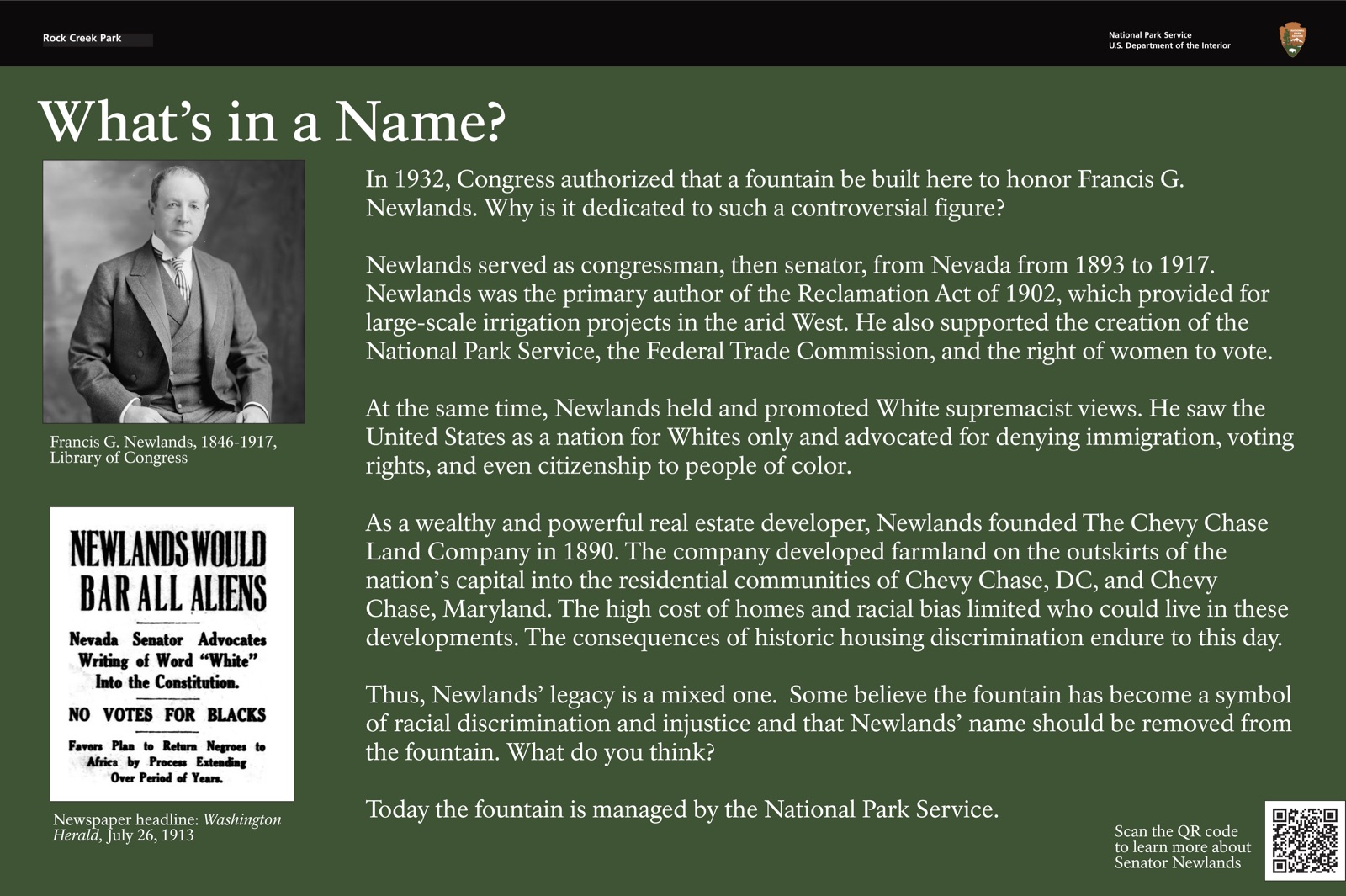
Photos courtesy Save Our Signs (public domain)
News Sources
VerifiedExplore the Full Map
See all 446 entries across every national park and wildlife refuge.
Open Interactive Map →