The Administration's Sanitized Replacement Panels, Revealed
On April 7, 2026, the NPS uploaded 11 proposed replacement panels to the official President's House web page. They reframe Washington's relationship with slavery in language that contradicts the documented scholarly consensus.
Updated April 9, 2026 · Compiled from the Philadelphia Inquirer, Seattle Times, NPS, and the historical record
On April 7, 2026, the National Park Service uploaded digital renderings of 11 replacement panels to the official President's House web page.[1] These panels are intended to replace the original 30-panel exhibition, 15 of which remain missing after being removed overnight on January 22, 2026.[2]
The new panels were designed and posted without the input of historians specializing in slavery, without consultation with the City of Philadelphia (as required by a federal injunction), and without any public comment period. City Solicitor Renee Garcia confirmed the federal government did not approach the city about the panels.[1]
The replacement panels present Washington as a conflicted figure caught between ideals and circumstance. Historians who have spent decades studying Washington and slavery say this framing omits critical, well-documented facts and redirects attention away from the experience of enslaved people. Below are the most consequential changes.[4]
| Original Panels (Removed) | Proposed Replacement Panels |
|---|---|
| "The Dirty Business of Slavery" Documented the economics of enslavement at the President's House: the buying and selling of human beings and the labor that built Washington's wealth. | Eliminated entirely. No replacement addresses Washington's direct financial dependence on enslaved labor. Morgan and Nicholls estimate Washington owned or managed ~670 people over his lifetime.[5] |
| "Life Under Slavery" Detailed the lived conditions of the nine enslaved people: rations, housing, punishment, and daily bondage in the President's House. | Eliminated entirely. The proposed panel instead states enslaved people "experienced a greater modicum of autonomy" and notes Washington bought them theater tickets.[6] |
| "History Lost & Found" Described the archaeological significance of the site, including how slavery there "undermined the meaning of freedom and mocked the nation's pretense to be a beacon of liberty."[7] | Title kept, content gutted. Slavery goes unmentioned. The replacement focuses on how archaeology works and the discovery of Washington's letters. The basement where enslaved people carried out daily labor is not acknowledged.[6] |
| "Oney Escapes!" Told the story of Ona Judge, Martha Washington's personal maid, who fled to freedom in 1796 because of her "thirst for compleat freedom."[8] | Reduced to a brief mention within a broader "Enslaved Members" list. The courage, drama, and historical significance of her escape are stripped away. |
| "Chef Hercules" Celebrated Hercules' extraordinary culinary talent and his decision to escape to freedom, one of the most powerful stories in the original exhibition. | Collapsed to a single line. Hercules is described as a chef who "ran away" in 1797. His story is no longer a standalone panel.[6] |
Below are examples of what the administration proposes to replace. On the left, original panels. On the right, the proposed replacements now posted on the NPS website. Click any image to enlarge.
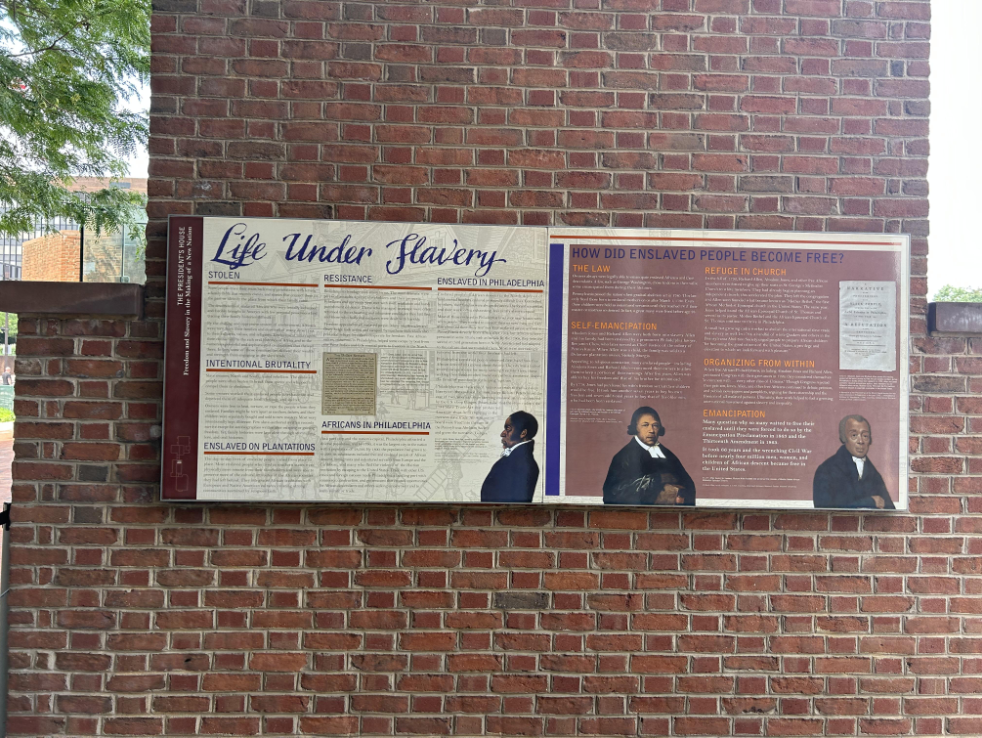
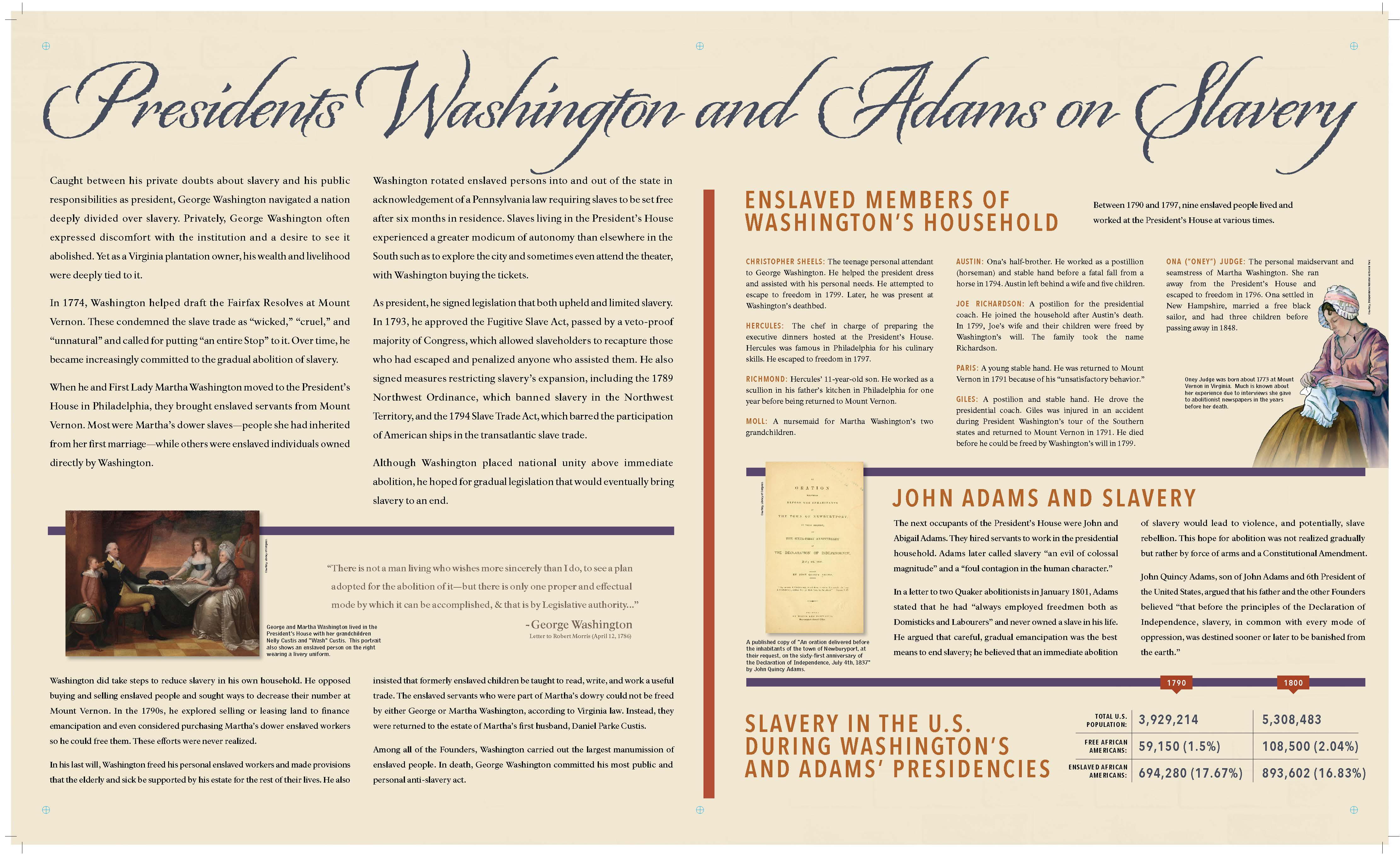
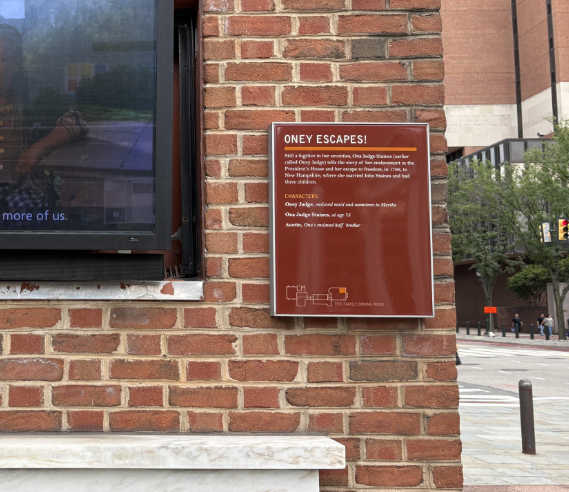
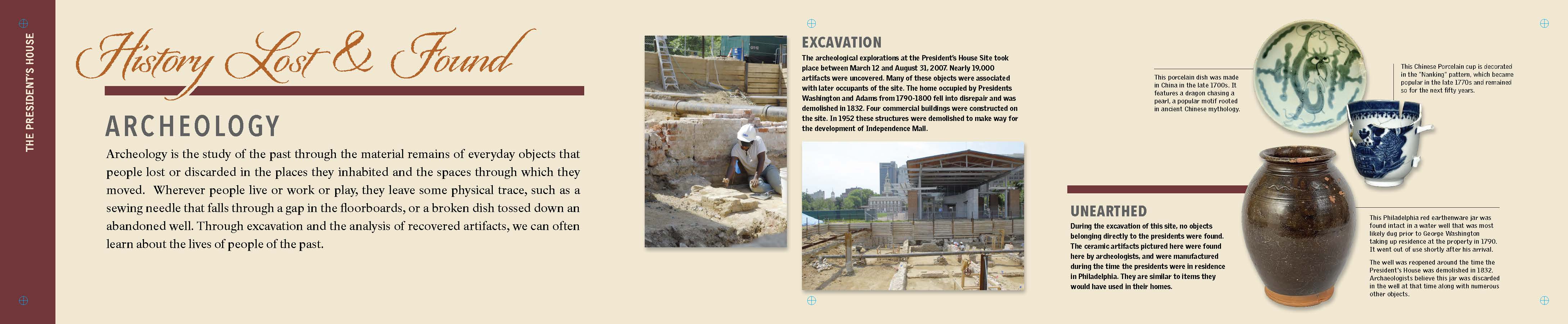
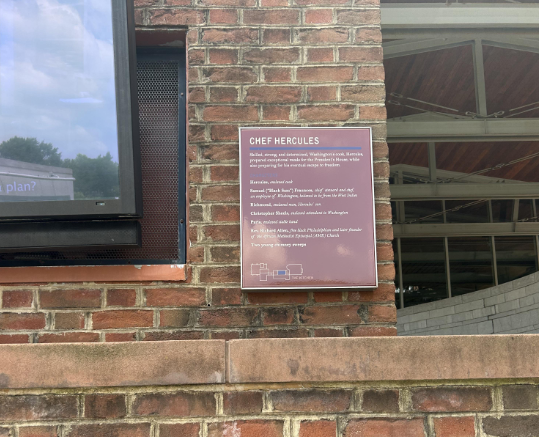
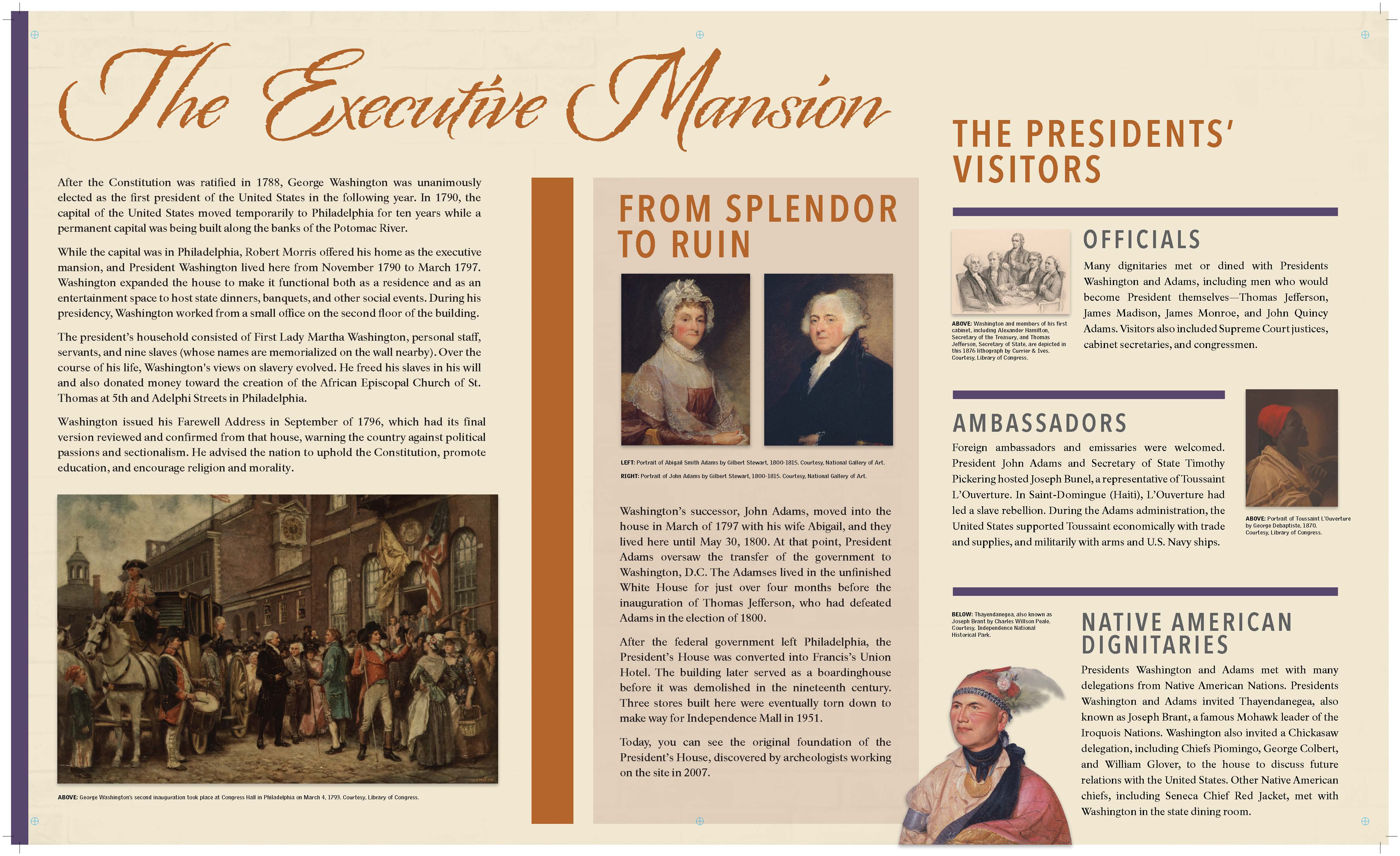
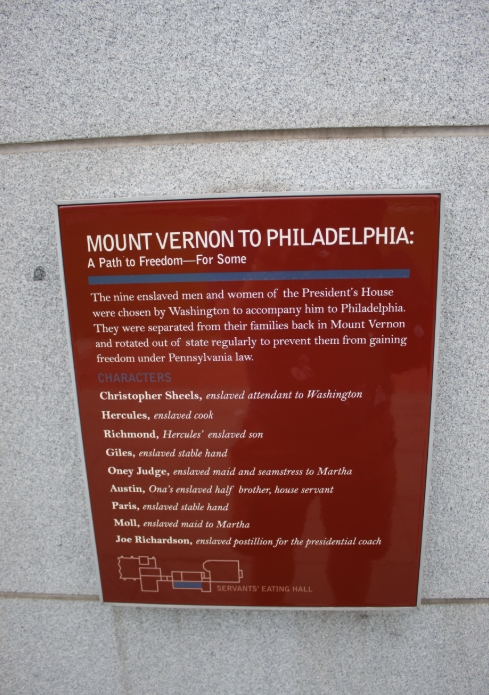
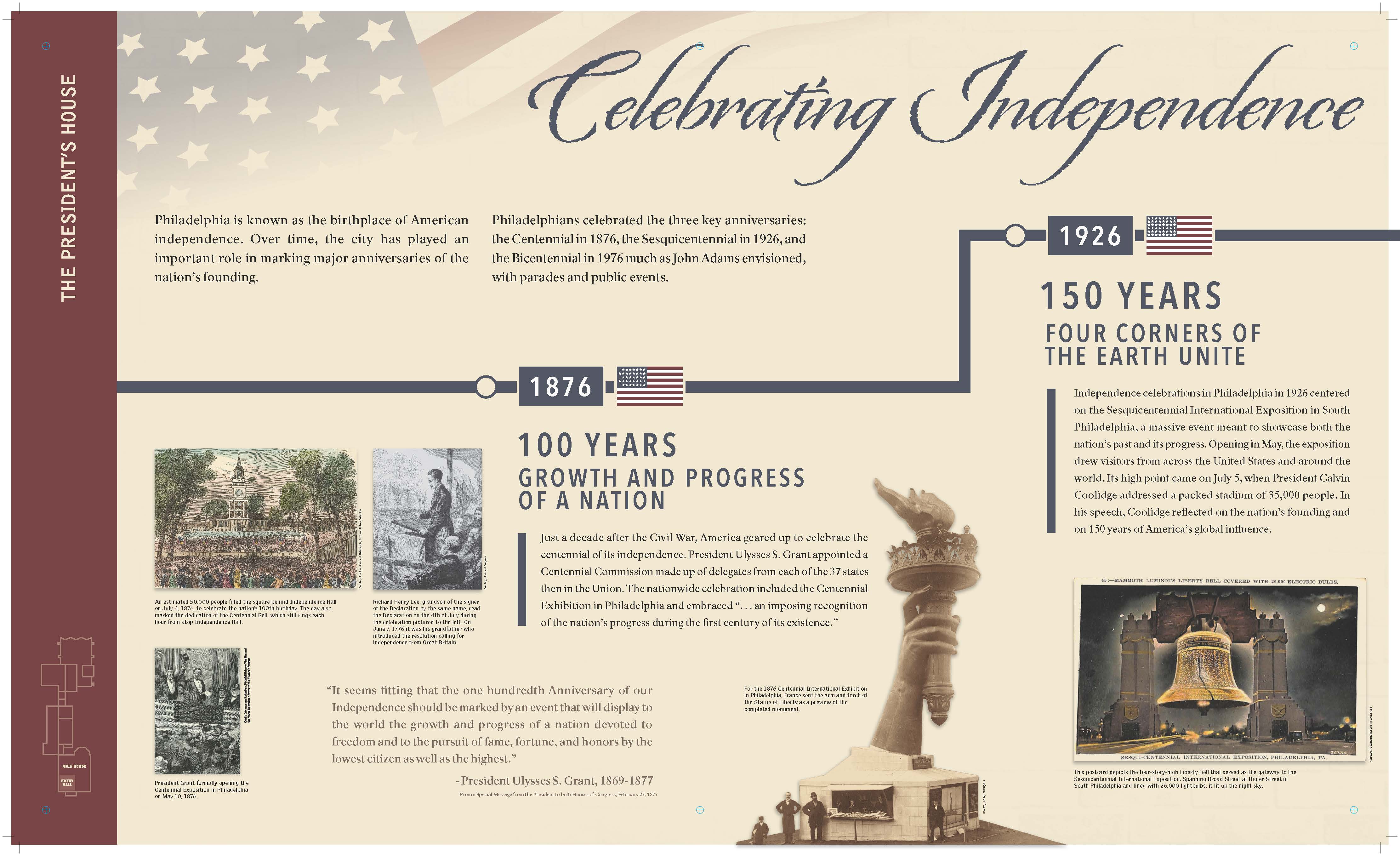
The proposed panels introduce carefully softened language that scholars say is designed to generate sympathy for Washington and minimize the realities of slavery. Below are direct excerpts from the NPS's proposed text, alongside what the documented historical record shows.
What the record shows: Washington did not simply "navigate" the slavery question. He actively circumvented Pennsylvania's gradual abolition law by rotating enslaved people out of the state before the six-month residency threshold, deliberately evading the law to maintain ownership of human beings.[9] He pursued Ona Judge for three years after her escape.[8] In 1766, he sold an enslaved foreman named Tom to a sugar plantation in Saint Kitts, effectively a death sentence given the brutal conditions of Caribbean sugar production.[10] The NPS's own archived documents acknowledge that Washington "knowingly acted to prevent these people of color from ever realizing or achieving the blessings of liberty."[7]
What the record shows: The argument that enslaved people at the President's House had it "better" than others is a classic minimization tactic that historians have consistently rejected. Erica Armstrong Dunbar's research on Ona Judge demonstrates that even the most "privileged" household servants fled at the first opportunity. Judge herself said she escaped because of her "thirst for compleat freedom."[8] Hercules, the celebrated chef described in the new panels as merely having "ran away," escaped from the most elite position an enslaved person could hold in Washington's household.[11] No theater ticket compensates for the absence of liberty.
What the record shows: Washington freed 123 people he legally owned. The 153 Custis dower enslaved people were divided among Martha's four grandchildren.[12] Many families had married across these ownership lines, so emancipation brought devastating separations alongside long-awaited freedom. Historian Marie Jenkins Schwartz has documented that none of Martha's descendants freed more than a handful of the Custis enslaved workers during their lifetimes.[13] The will was a genuine act, but presenting it as the whole story omits the consequences for those it could not reach.
The following synthesis draws on the work of the most respected historians in this field: Jill Lepore (Harvard), Mary V. Thompson (Mount Vernon Research Historian), Henry Wiencek, Philip D. Morgan (Johns Hopkins), Erica Armstrong Dunbar (Rutgers, then Duke), Edward Lawler Jr., Gary Nash (UCLA), Edmund S. Morgan (Yale), the research teams at Mount Vernon, and the NPS's own published scholarship. The proposed panels contradict this consensus at multiple points.
Scale of enslavement. Washington inherited his first ten enslaved people at age eleven, when his father Augustine died in 1743.[10] His marriage to Martha Dandridge Custis in 1759 brought approximately 84 more under his control as "dower" property.[14] Over his lifetime, historians Philip D. Morgan and Michael L. Nicholls estimate he owned or managed approximately 670 people.[5] At his death on December 14, 1799, 317 enslaved people lived at Mount Vernon: 124 owned by Washington, 153 belonging to the Custis dower estate, and 40 rented from neighboring planters.[12] Enslaved people made up roughly 90 percent of the estate's population.[15]
Conditions were harsh. Standard rations consisted of cornmeal and salted fish.[16] Housing on outlying farms was a rough one-room log cabin with mud-daubed walls and a wooden chimney; a visitor in 1797 described the quarters as deplorable.[17] Mary V. Thompson, Mount Vernon's own research historian, found that Washington was "remarkably strict and distrustful of virtually everyone who worked for him."[18] Of 96 married enslaved people at Mount Vernon in 1799, only 36 lived together. Thirty-eight had spouses on separate farms within the estate, and 22 had spouses on entirely different plantations. Wiencek concluded that Washington "institutionalized an indifference to the stability of enslaved families."[19]
Punishment was real. Washington approved of physical punishment when he judged other methods had failed.[12] In 1793, when an enslaved seamstress named Charlotte refused to work, farm manager Anthony Whitting whipped her with a hickory switch, a punishment Washington did not condemn.[12] An English neighbor, Richard Parkinson, reported that it was "the sense of all his neighbors that he treated his slaves with more severity than any other man." A Polish visitor, Count Julian Niemcewicz, who spent twelve days at Mount Vernon, said Washington treated them "far more humanely than do his fellow citizens of Virginia."[14][15] These divergent accounts illustrate that conditions varied, but they do not support the benign picture presented in the proposed panels.
Resistance was constant. At least 47 enslaved people fled Mount Vernon during Washington's lifetime, according to Jill Lepore's review of Washington's correspondence.[20] Among the most significant was Harry Washington, born in Gambia around 1740, purchased by George Washington and sent to drain the Great Dismal Swamp. Harry escaped in 1775 to join Lord Dunmore's British forces, was resettled in Nova Scotia, and eventually helped lead a rebellion in Sierra Leone. Lepore uses Harry's story as a structural counterpoint throughout These Truths, elevating him to the status of a "Founder, too."[20][21] Lepore argues that fear of British abolitionism, catalyzed by Dunmore's 1775 proclamation offering freedom to enslaved people who joined the British, was itself a driving force behind American independence.[20][22]
The Pennsylvania loophole is among the most damning episodes. While serving as president in Philadelphia, Washington was subject to Pennsylvania's gradual abolition law, which would have automatically freed any enslaved person residing in the state for six continuous months. Rather than accept this, Washington systematically rotated his enslaved household servants back to Virginia before the deadline.[9][14] The NPS's own archived analysis called the President's House "the living incarnation of the essential and inescapable contradiction of American history: that ours is a nation established around the keystone principles of individual freedom and equality for all, but one that is built on a foundation of slavery."[7]
The will was significant but incomplete. Washington ordered the 123 enslaved people he owned outright to be freed upon Martha's death, making him the only slaveholding Founding Father from the South to free all of his own enslaved people.[12][15] He also stipulated that elderly or infirm formerly enslaved people be supported by his estate, and that children without parents be educated in reading, writing, and a useful trade.[14] But he could not legally free the 153 Custis dower enslaved people, and many families were split apart when freedom came for some but not others. As historian Henry Wiencek wrote, Washington's contradictory attitudes remain "one of the mysteries of his life."[19]
The President's House Site exists because of a decade-long, Black-led advocacy campaign that forced the National Park Service to confront slavery at Independence Mall. Historian Edward Lawler Jr.'s 2002 article about the President's House ignited a public controversy that lasted over eight years, as Black activists, historians, and eventually NPS leadership fought to acknowledge slavery at a site previously presented only as a story of presidential power.[23] The project cost $10.5 million. Archaeological excavations in 2007 revealed physical remains of the building just five feet from the entrance to the Liberty Bell Center, a visceral juxtaposition of America's symbol of freedom with the infrastructure of enslavement.[7][23]
The original panels were not opinion. They were the product of archaeological research, archival scholarship, and professional historical practice, vetted by the NPS's own historians. They were removed under an executive order directing the Park Service to flag content that "inappropriately disparages Americans past or living."[24] That language is now being used to replace documented history with sympathetic framing.
- Jan 22, 2026 All 30 original panels removed overnight from the President's House Site.[2]
- Feb 16, 2026 Judge Cynthia Rufe orders restoration of panels, citing Orwell's 1984 in a blistering opinion.[3]
- Feb 19, 2026 14 panels partially restored. 15 remain missing. Third Circuit issues administrative stay on further restoration.[2]
- Mar 19, 2026 NPCA coalition files for preliminary injunction to halt NPS censorship system-wide.[2]
- Apr 7, 2026 NPS quietly uploads 11 sanitized replacement panel renderings to the President's House web page. No historian consultation. No city notification.[1]
- Apr 8, 2026 Philadelphia Inquirer and Seattle Times report on the proposed panels.[1][25]
This is not a disagreement about historical interpretation. The proposed replacement panels contradict a documented, peer-reviewed, multi-institutional scholarly consensus on Washington and slavery. They remove the voices of enslaved people from a memorial that was built specifically to honor them. They replace documented fact with sympathetic framing in service of a political narrative.
The nine enslaved people who lived in the President's House during Washington's presidency were Ona Judge, Hercules, Christopher Sheels, Richmond, Moll, Austin, Joe Richardson, Paris, and Giles.[6][14] Their stories were told in the original exhibition. In the proposed replacement, their individual stories are largely gone.
Help Restore America's History
The President's House case shows how legal action and public attention can restore historical truth. Support efforts to bring back the remaining 15 panels and challenge similar removals across the national park system.
Sources & Endnotes
- Roth, Fallon, and Abraham Gutman. "George Washington's role as an enslaver is sanitized in proposed President's House panels posted online." Philadelphia Inquirer, April 8, 2026.
- Save Our Signs Removal Tracker. Comprehensive database of removed, restored, and missing panels at the President's House Site. See also: PBS NewsHour, "Citing Orwell's 1984, judge orders restoration of slavery exhibit," Feb 16, 2026.
- City of Philadelphia v. Doug Bergum, No. 2:26-cv-00434 (E.D. Pa. Feb. 16, 2026). Civil Rights Litigation Clearinghouse.
- Comparison based on original panels documented by Save Our Signs Removal Tracker and proposed panel renderings posted to NPS President's House page, April 7, 2026.
- Morgan, Philip D., and Michael L. Nicholls. "Slave Flight: Mount Vernon, Virginia, and the Wider Atlantic World." In George Washington's South, eds. Tamara Harvey and Greg O'Brien. University Press of Florida, 2004.
- National Park Service, proposed replacement panels for the President's House Site, posted to nps.gov, April 7, 2026.
- National Park Service. The Archeology of Freedom and Slavery: President's House Excavations. Archived at npshistory.com.
- Dunbar, Erica Armstrong. Never Caught: The Washingtons' Relentless Pursuit of Their Runaway Slave, Ona Judge. New York: 37 Ink/Atria, 2017. See also Encyclopedia Virginia, "George Washington and Slavery."
- White House Historical Association. "The Enslaved Household of President George Washington." See also Encyclopedia Virginia; Mount Vernon Digital Encyclopedia.
- Mount Vernon. "The Growth of Mount Vernon's Enslaved Community." mountvernon.org.
- Encyclopedia Virginia, "George Washington and Slavery," updated November 7, 2024. Mount Vernon Digital Encyclopedia, "George Washington and Slavery."
- Mount Vernon. "Ten Facts About Washington & Slavery." mountvernon.org.
- Schwartz, Marie Jenkins. Cited in HISTORY.com, "Did George Washington Really Free Mount Vernon's Enslaved Workers?" Updated January 31, 2025.
- Mount Vernon. "George Washington and Slavery." Digital Encyclopedia, mountvernon.org. Research by Mary V. Thompson.
- Encyclopedia Virginia, "Enslaved Community at Mount Vernon." Mary Thompson, updated August 26, 2024.
- Mount Vernon. "Slavery at Mount Vernon." mountvernon.org.
- Mount Vernon. "Quarters for Enslaved People." Digital Encyclopedia, mountvernon.org.
- Thompson, Mary V. "The Only Unavoidable Subject of Regret": George Washington, Slavery, and the Enslaved Community at Mount Vernon. Charlottesville: University of Virginia Press, 2019.
- Wiencek, Henry. An Imperfect God: George Washington, His Slaves, and the Creation of America. New York: Farrar, Straus and Giroux, 2003.
- Lepore, Jill. These Truths: A History of the United States. New York: W.W. Norton, 2018. See also Dan Kennedy, "Looking back at Jill Lepore," dankennedy.net, September 30, 2025.
- "Only Dead Metaphors Can Be Resurrected: A Review of Jill Lepore." European Journal of American Studies.
- Wilentz, Sean. "The American Revolutions." The New York Review of Books, November 8, 2018. Cep, Casey. Review of These Truths. Harvard Magazine, September 2018. The Guardian, "These Truths review," January 26, 2019.
- Murphy, Jim. "George Washington." Real Philly History, February 2, 2024. Citing NPS sources, the New York Times, and historians Edward Lawler Jr. and Gary Nash.
- Executive Order 14253, "Restoring Truth and Sanity to American History," signed March 27, 2025. Secretary's Order 3431, issued May 20, 2025 by Interior Secretary Doug Burgum.
- Roth, Fallon, and Abraham Gutman. "Trump administration's panels for historical site altered Washington's role in slavery." Seattle Times / Tribune Content Agency, April 8, 2026.
Selected Bibliography
- Morgan, Edmund S. American Slavery, American Freedom: The Ordeal of Colonial Virginia. New York: Norton, 1975.
- Nash, Gary B. The Forgotten Fifth: African Americans in the Age of Revolution. Cambridge: Harvard University Press, 2006.
- Berlin, Ira. Many Thousands Gone: The First Two Centuries of Slavery in North America. Cambridge: Harvard University Press, 1998.
- Baptist, Edward E. The Half Has Never Been Told: Slavery and the Making of American Capitalism. New York: Basic Books, 2014.
- Finkelman, Paul. Slavery and the Founders: Race and Liberty in the Age of Jefferson. 3rd ed. New York: Routledge, 2014.
- Furstenberg, François. "Atlantic Slavery, Atlantic Freedom: George Washington, Slavery, and Transatlantic Abolitionist Networks." William and Mary Quarterly, Vol. 68, No. 2 (April 2011).
- Lawler, Edward Jr. "The President's House in Philadelphia: The Rediscovery of a Lost Landmark." Pennsylvania Magazine of History and Biography, Vol. 126, No. 1 (January 2002).
- Hannah-Jones, Nikole, ed. The 1619 Project: A New Origin Story. New York: One World, 2021.
- NPS. George Washington Birthplace National Monument Historic Resource Study. Archived at npshistory.com.