Arlington House, The Robert E. Lee Memorial
Park History
Sourced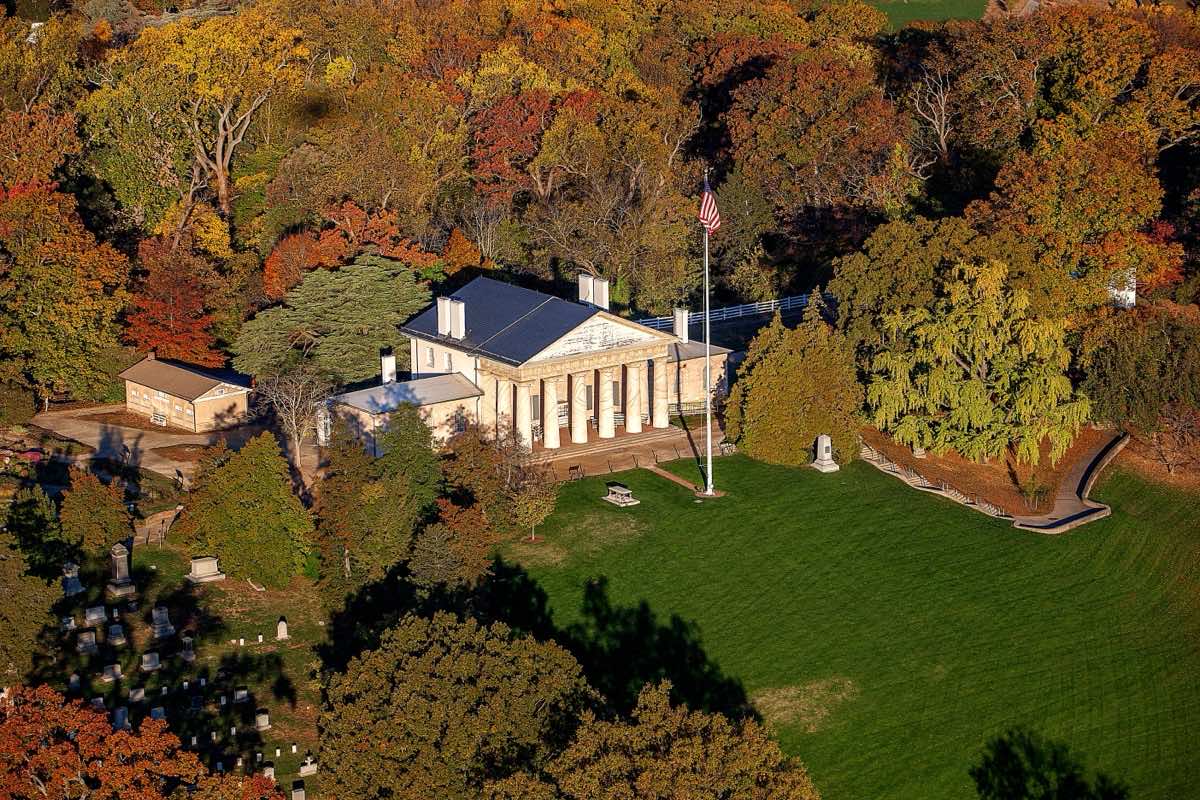
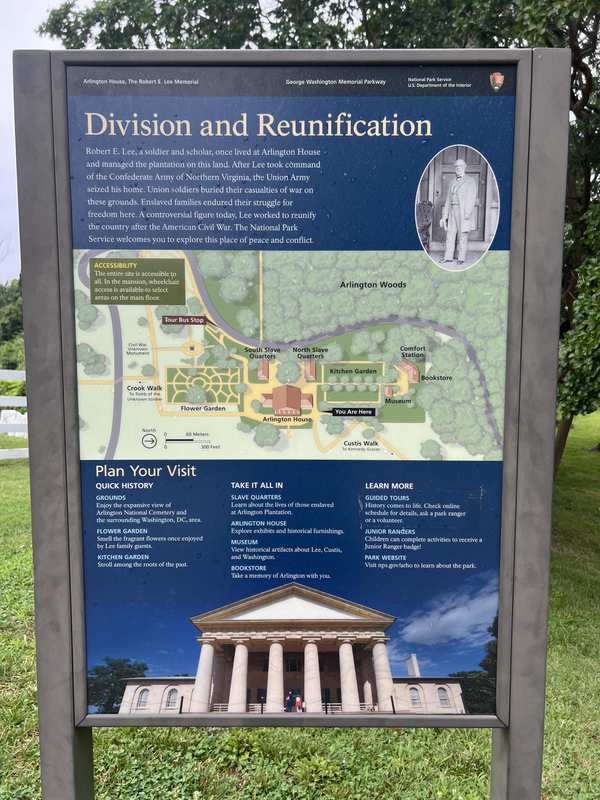
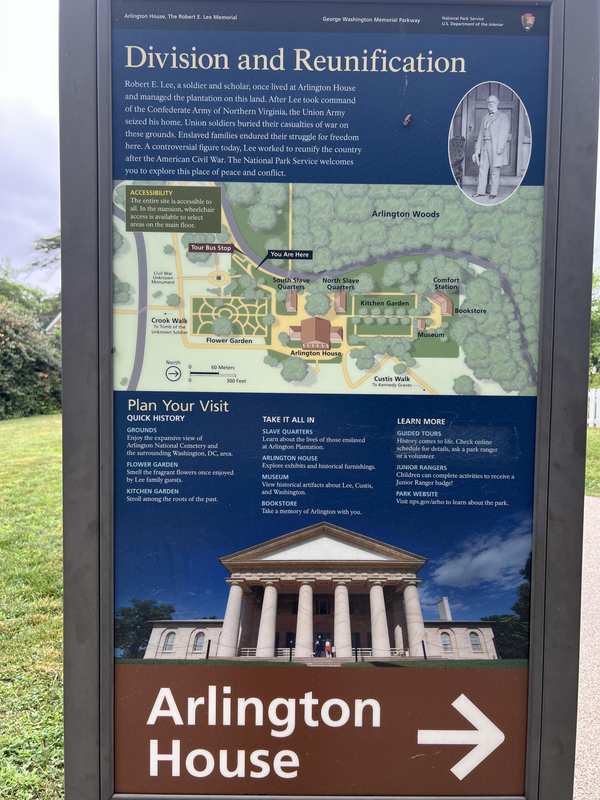
Arlington House stands on a high ridge above the Potomac River, its massive portico facing Washington, D.C. George Washington Parke Custis, Martha Washington’s grandson, was raised by Martha and George Washington; when she died in 1802 he inherited 1,100 acres on the Potomac and the people she had enslaved. Between 1802 and 1818 enslaved workers and free labor built his house, modeled on a Greek temple, as the first memorial to George Washington and a museum for the family’s Washington heirlooms. [1] [2]
In 1831 his only surviving child, Mary Anna Randolph Custis, married Lt. Robert E. Lee in the family parlor. For thirty years the house was the Lees’ home and a working plantation where enslaved people numbered as many as 63 at one time. In April 1861 Lee resigned from the U.S. Army and sided with Virginia; Union troops occupied the heights, the Army built a Freedmen’s Village on the estate in 1863, and in 1864 it declared 200 acres a military cemetery — the beginning of Arlington National Cemetery. By August 1864, the Park Service’s 2015 foundation document says, more than two dozen soldiers had been buried within a few yards of the mansion to keep the Lee family from returning. [1] [2]
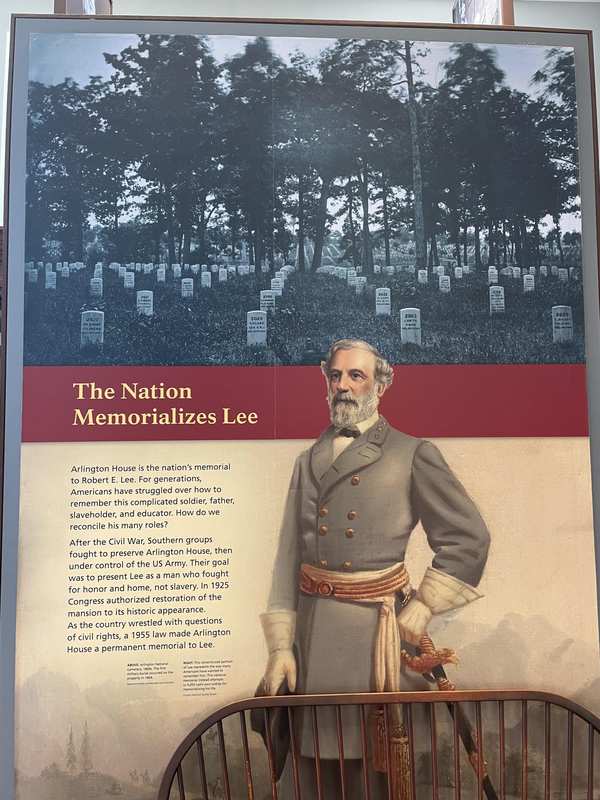
A 1925 joint resolution of Congress authorized restoring the mansion as a memorial to Lee; the Park Service took it over in 1933, and it was redesignated Arlington House, The Robert E. Lee Memorial in 1972. Only 19 of Custis’s original 1,100 acres lie within the memorial. The 2010 park brochure presents Lee as a figure of post-war reconciliation; the 2015 foundation document also names “Slavery and Freedom” as one of the park’s five interpretive themes and counts the two slave quarters among its fundamental resources. [3] [1] [2]
Women
After her father’s death in 1857 Arlington was legally owned by Mary Anna Custis Lee, though her husband became its master. From her mother’s death in 1853 she managed the household and its enslaved workers despite worsening rheumatoid arthritis; she and her daughters grew roses in the flower garden and sold them to help the American Colonization Society send freed slaves to Liberia. When she left in May 1861 she handed her keys to Selina Gray, who guarded the family’s possessions; by January 1862 Gray found that boxes of Mount Vernon relics had been broken into and reported the theft to General McDowell. In 1864 the government took the estate when Mrs. Lee could not appear in person to pay its taxes. Visiting shortly before her death in 1873, she wrote that it seemed but a dream of the past. [4] [1] [5]
Black history
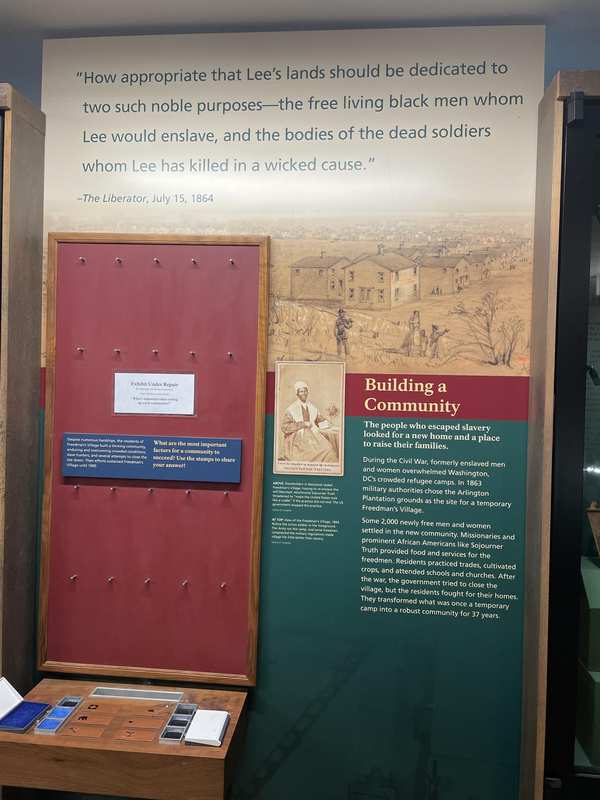
The war turned the estate into a refuge. In 1863 the Army founded Freedmen’s Village on roughly 400 acres in the south of the property for people who had escaped or been freed from slavery and come to Washington: it had homes, churches, a school and a hospital, and from 1866 to 1868 residents rented ten-acre parcels of the old estate to farm their way to independence. Quartermaster General Montgomery Meigs laid out the 200-acre cemetery so it would not interfere with the village, but wanted soldiers buried nearer the mansion to prevent its future use as a residence. By January 1871 the cemetery’s records counted about 4,100 Black burials — 343 U.S. soldiers and 3,757 former slaves. Once the courts gave the United States clear title, the Army moved to remove civilians from the military reservation: according to the 2024 landscape inventory, the village’s 763 residents were evicted and it was disbanded around 1900 (the 2010 brochure says all were gone by 1890). [4] [5] [1]
Slavery
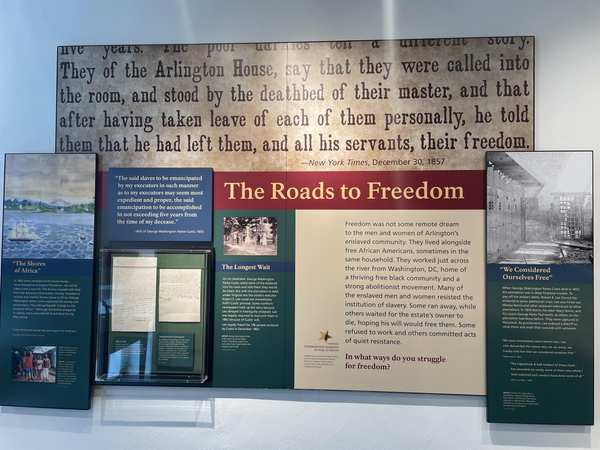
George Washington Parke Custis’s will freed the people he held in slavery no later than five years after his death, provided the estate was solvent. He died in 1857; Lee, as executor, managed more than 60 enslaved workers, and in December 1862 he was obliged to carry out the will. The 2010 park brochure quotes Lee calling slavery a moral and political evil while holding that only Providence should decide its fate. Household workers lived in twin quarters built to echo the mansion; Selina Gray, the head housekeeper, lived with her family in one room of the south quarters. [1]
In 1826 Custis gave Maria and Charles Syphax a 17-acre parcel on the estate’s southern edge, where a church for the enslaved community also stood; only in 1865 were they allowed to buy it legally. On March 3, 1930, two of Thornton and Selina Gray’s daughters, Annie Baker (77) and Ada Thompson (73), toured the house with architect L. M. Leisenring and described how its rooms had been used. [4] [5]
Sources
- NPSHistory.com: Arlington House archive page — overview (from the 2010 NPS brochure) and establishment block
- Foundation Document Overview, Arlington House, The Robert E. Lee Memorial, Virginia (NPS, January 2015)
- Snell, Historic Structure Report, Historical Data Section, Vol. I: Arlington House (NPS, 1985), ch. I, Significance of Arlington House
- Cultural Landscapes Inventory: Arlington House (NPS, 2009, rev. 2024), Summary p. 3
- Snell, Historic Structure Report, Historical Data Section, Vol. I (NPS, 1985), ch. III, C.1, Military Headquarters, 1861–64
REVISE: Exhibit panels (8 items)
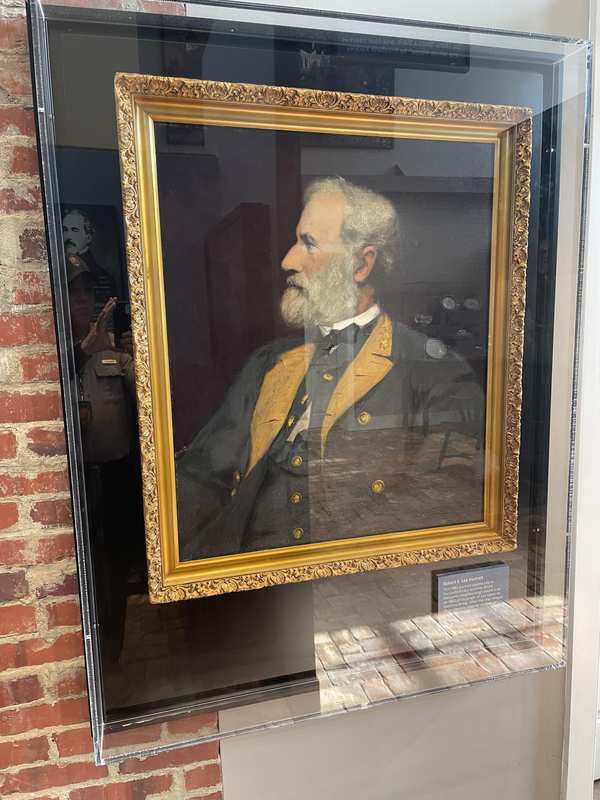
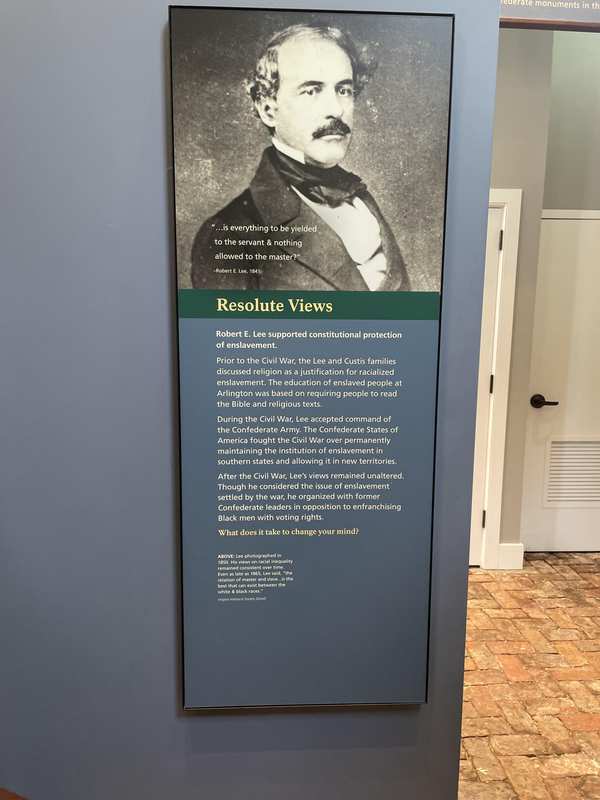
Arlington House in DC preserves a piece of American history that the public has trusted the National Park Service to protect and interpret. The exhibit panels at this site have been developed over years by historians, subject-matter experts, and park staff — and are now being reviewed under Secretary's Order 3431.
From the internal review records: “We are submitting photos of all of the exhibits found within the museum at Arlington House, Robert E. Lee Memorial. This site was designated by Congress as a memorial to Robert E Lee. The museum was designed as a space dedicated to the life and legacy of Robert E. Lee. All material within the museum presents a balanced narrative of his life and influence. We decided to submit all exhibits so the...”
Why this matters: Arlington House is part of a network of over 400 national parks that serve as America's classrooms. The interpretive materials here were developed by subject-matter experts to help visitors understand the full story of this place. When historically accurate content is removed, the public loses access to its own history.
8 photos (398-404 & 406)
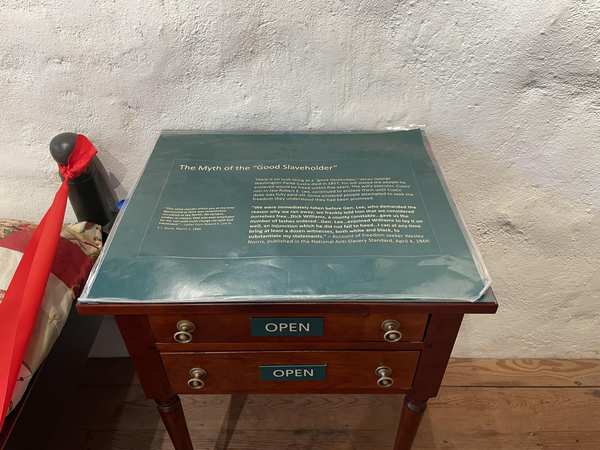
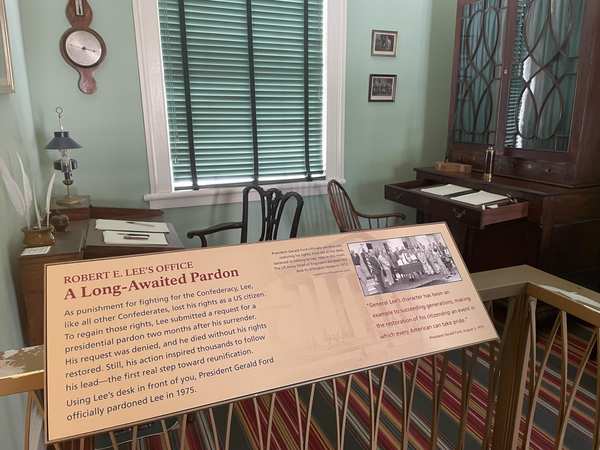
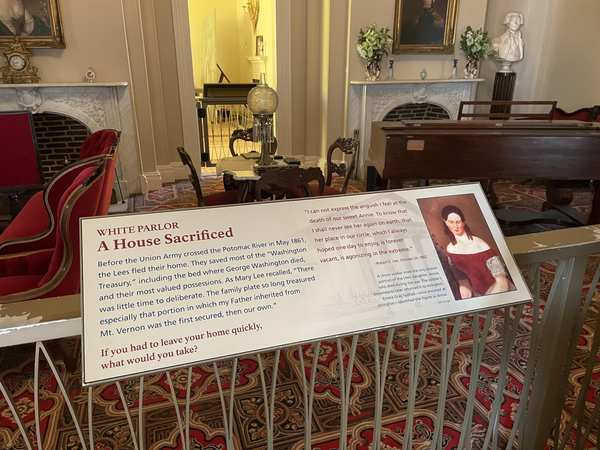
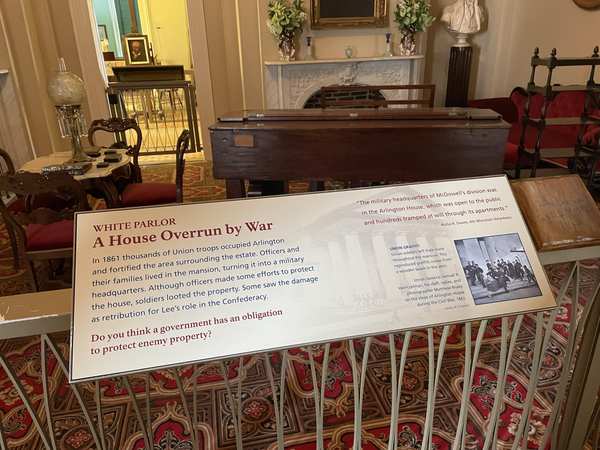
We are submitting photos of all of the exhibits found within the museum at Arlington House, Robert E. Lee Memorial. This site was designated by Congress as a memorial to Robert E Lee. The museum was designed as a space dedicated to the life and legacy of Robert E. Lee. All material within the museum presents a balanced narrative of his life and influence. We decided to submit all exhibits so they can be reviewed in their entirety.
Photographs attached to this park's records in the leaked NPS review database.
Explore the Full Map
See all 446 entries across every national park and wildlife refuge.
Open Interactive Map →