Timucuan Ecological & Historic Preserve
Park History
Sourced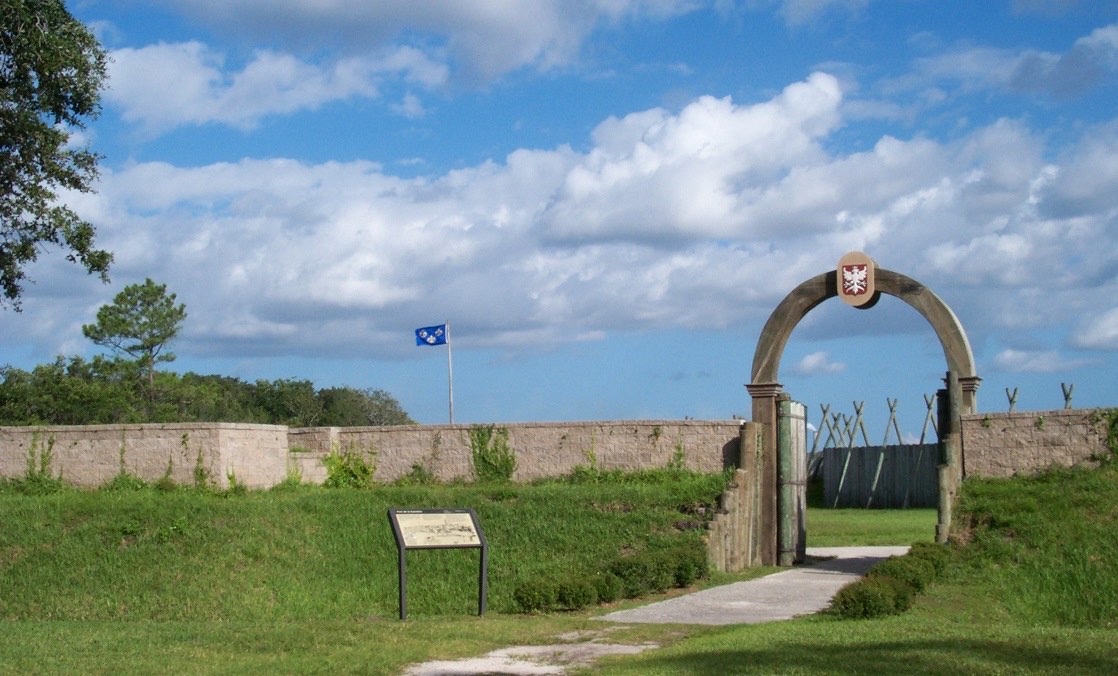
Where the St. Johns and Nassau rivers meet the Atlantic, Timucuan Ecological and Historic Preserve protects one of the largest remaining salt marsh estuaries on the Southeast coast: 46,000 acres of salt marsh, coastal dunes, hardwood hammocks and fresh, brackish and salt water inside the city limits of Jacksonville, with dolphins, migratory birds, manatees, wood storks and loggerhead sea turtles. More than 200 archeological sites, among them Archaic shell rings, record over 6,000 years of human habitation. Congress created the preserve in 1988 around Fort Caroline National Memorial, authorized in 1950; only 8,430 acres, 18 percent of the preserve, are federally owned. [1]
Fort Caroline recalls la Caroline, the colony of mostly Huguenot settlers that René de Laudonnière planted on the river’s south bank in 1564 — by the park brochure’s account the first French colony in what is now the United States. In September 1565 Spanish forces under Pedro Menéndez de Avilés captured it and massacred most of its defenders; the brochure calls the battles here the first time European nations fought for control of lands in what is now the United States. [2]
On Fort George Island, Kingsley Plantation keeps a 1798 plantation house and the ruins of the tabby cabins where enslaved people lived; the foundation document calls it the oldest surviving example of an antebellum Spanish Colonial plantation. The preserve also includes American Beach on Amelia Island, which the same document calls the largest and most popular beach resort established by and for African Americans in the Jim Crow era. [1]
Indigenous peoples
The preserve is named for the Timucua. Their ancestors lived along the St. Johns estuary for thousands of years and left the shell mounds found throughout the preserve. The people who met the French in 1562 under Chief Saturiwa were one of several Timucua-speaking groups of north and central Florida and southeastern Georgia; they fished, gathered oysters and clams, hunted, planted maize, squash and beans, and traveled in dugout canoes. They shared food with the colonists and helped build their fort, and later helped French forces recapture it in 1568. Spain then imposed tribute, forced them into missions, and European disease devastated them: from a population once in the tens of thousands, the park brochure says, only 550 were recorded in 1698, and no known Native people today call themselves Timucua. [2] The 2012 foundation document states they were extinct as a people by 1752. [1]
Women
Anta Majigeen Ndiaye was thirteen, the study says, when Kingsley bought her in Havana in 1806; the special history study, following Senegalese historian Abdou Cisse, identifies her as the daughter of a member of the royal lineage of Jolof, enslaved after her father’s failed challenge for the throne. The study describes Kingsley’s sexual exploitation of her; she was pregnant with his son when she reached his Laurel Grove plantation. Freed with her three children in 1811, Anna Kingsley managed his plantations in his absence. [3] She acquired land and enslaved people of her own; after Florida became a U.S. territory in 1821, oppressive new laws led Anna, her two sons and some former slaves to move to Haiti in 1837. She returned to Jacksonville and died in 1870. [2] The study also records Nansy, who in 1792 petitioned the Spanish governor that she and her husband had freed themselves during the Revolution; no further record of her petition survives. [3]
Slavery
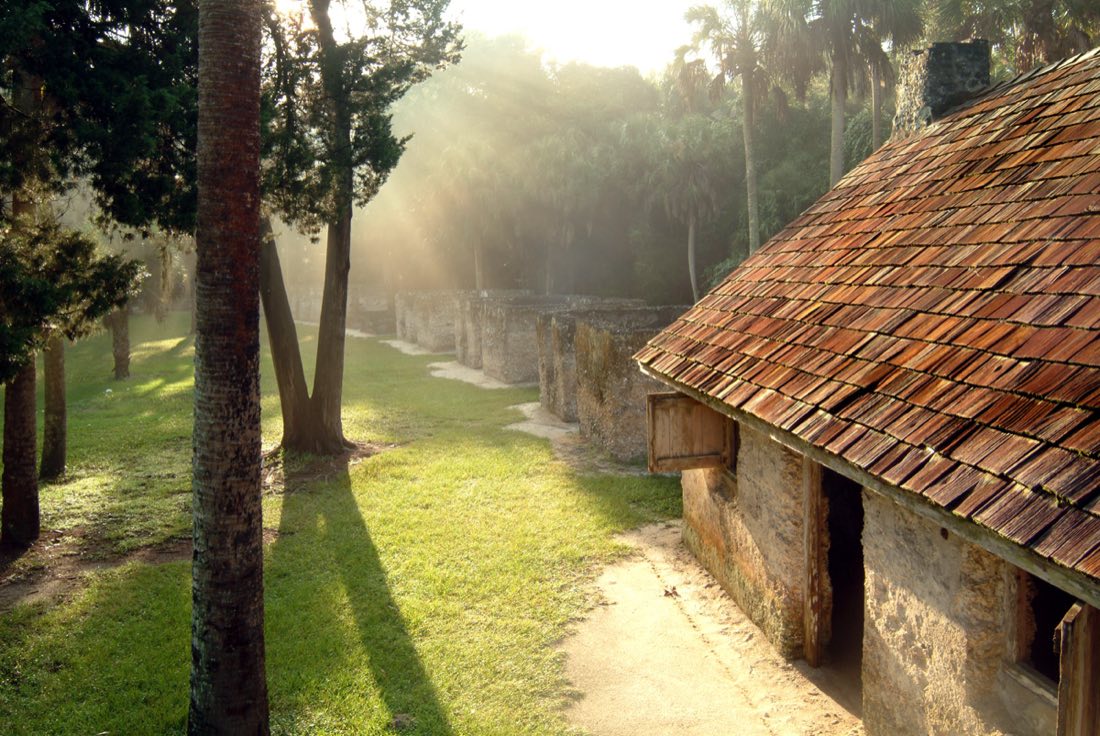
Kingsley Plantation’s cabins are the largest concentration of tabby slave quarters in the United States, the foundation document says. [1] Amani T. Marshall’s 2022 Park Service study traces the hundreds of enslaved people on Fort George Island. John McQueen, granted the island in 1791, had brought more than 300 enslaved people, many of whom considered themselves free and had likely been re-enslaved by him after the Revolution; slave trader Zephaniah Kingsley rented the island from 1814 and bought it in 1817. Laborers worked by the task system and could sell crops from their own plots. But stocks have been found in the main-house basement (staff are unsure whether they were used there), and after Kingsley’s death in 1843 his nephew Charles McNeill, at the San Jose plantation, flogged Romeo, and when Romeo ran away offered a reward for him “dead or alive.” Marshall concludes that the evidence contradicts Kingsley’s claims of mild discipline, and calls the violence torture. [3]
Climate & environment
Most of the preserve is salt marsh. A 2024 U.S. Geological Survey fact sheet prepared with the Park Service estimates that about 81 percent of its non-water area is likely to be inundated by 2050 under an intermediate-low sea-level scenario, and about 88 percent by 2100 under an intermediate-high scenario, and it pictures Fort Caroline flooded after Hurricane Ian in September 2022. [4] The Park Service’s 2024 climate futures summary for Fort Caroline finds that the area has warmed at a rate of 6 °F per century since 1970, and that the amount of rain falling in the region’s heaviest storms has risen 37 percent since 1958. [5]
Sources
- Foundation Document, Timucuan Ecological and Historic Preserve, Florida (NPS, 2012)
- NPSHistory.com: Timucuan Ecological and Historic Preserve / Fort Caroline archive page — overview (NPS brochure texts) and establishment block
- Amani T. Marshall, The Enslaved Communities on Fort George Island: A Special History Study for Timucuan Ecological & Historic Preserve (NPS/OAH, March 2022)
- USGS Fact Sheet 2024–3008, Projected Sea-Level Rise and High Tide Flooding at Timucuan Ecological and Historic Preserve, Florida (June 2024)
- NPS Climate Change Response Program, Fort Caroline National Memorial Climate Futures Summary (2024)
Removed Per Nps Court Filing: Film/video, exhibit panels, publications (12 items)
At Timucuan Ecological & Historic Preserve, the National Park Service has worked for years to document and interpret the history of slavery at this site — a history that was ignored for much of the park's existence. The exhibits, waysides, and publications now under review represent a hard-won commitment to telling the complete American story.
From the internal review records: “Certain text on the exhibits or waysides may be disparaging towards the U.S. Some text describes the horrid conditions the enslaved endured during their transport to the Americas; certain panels discuss the differences between slavery in Spanish Florida and the United States; panels discuss the race discrimiation laws that were passed once Spanish Florida became part of the U.S.; exhibits have exc...”
Why this matters: The history of slavery at Timucuan Ecological & Historic Preserve was suppressed for generations. The materials now being targeted represent decades of work by historians, descendants of enslaved people, and community advocates to ensure these stories are finally told. Removing them would re-erase history that has only recently been acknowledged.
- “Exhibit panels in Visitor Center” — removed per NPS court filing
- Exhibit panels in Visitor Center; reason: Unrelated to beauty, abundance, and grandeur of the natural landscape; now: At the park
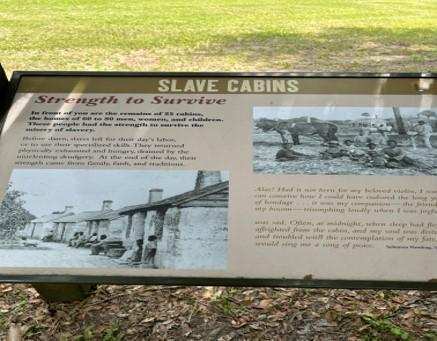
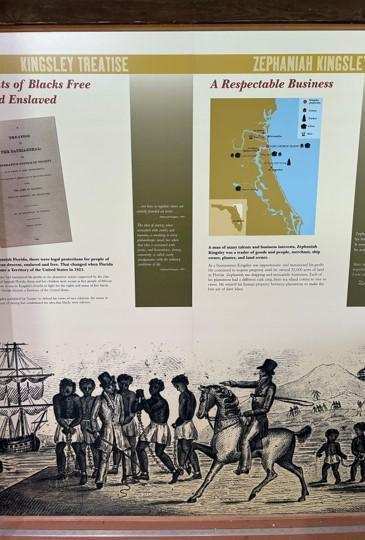
The attached images are from exhibit panels and waysides at the Kingsley Plantation which may be in conflict with SO 3431 or EO 14253. The site interprets the history of slavery in Florida.
Many images depict the torture of the enslaved women by colonial men; depict the horrid conditions the enslaved endured during their transport to the Americas; depict artifacts, like ankle racks, which were used to torture the enslaved at Kingsley Plantation; depict images of enslaved women having their children forcibly removed by men of a different color; show images of enslaved men and children in chains alongside men with brandishing whips; show images of torture scars on the backs of the enslaved; and images women and children being tortured by men with a different complexion with a cattle whip.
Certain text on the exhibits or waysides may be disparaging towards the U.S. Some text describes the horrid conditions the enslaved endured during their transport to the Americas; certain panels discuss the differences between slavery in Spanish Florida and the United States; panels discuss the race discrimiation laws that were passed once Spanish Florida became part of the U.S.; exhibits have ex...
Explore the Full Map
See all 446 entries across every national park and wildlife refuge.
Open Interactive Map →